How can algo trading help during a falling stock market?
Algo trading can use predefined rules and market data to identify trading opportunities during both rising and falling markets, helping reduce emotional decision-making and automate trade execution. However, profits are never guaranteed.
Table of Contents
- Chapter 1: NIFTY's 3-Week Downtrend
- Chapter 2: What Happens When the Market Keeps Falling?
- Chapter 3: Manual Trading vs Algorithmic Trading
- Chapter 4: The Result: Nearly ₹18 Lakh in Reported Gross P&L
- Chapter 5: Why Data Matters More Than Emotions
- Chapter 6: Why Retail Traders Are Looking at Algo Trading
- Chapter 7: Q7 Trading Solutions: Making Trading More Systematic
- Frequently Asked Questions (FAQs)
The stock market does not always reward traders simply because they correctly predict its direction. Sometimes, the bigger challenge is surviving the volatility.
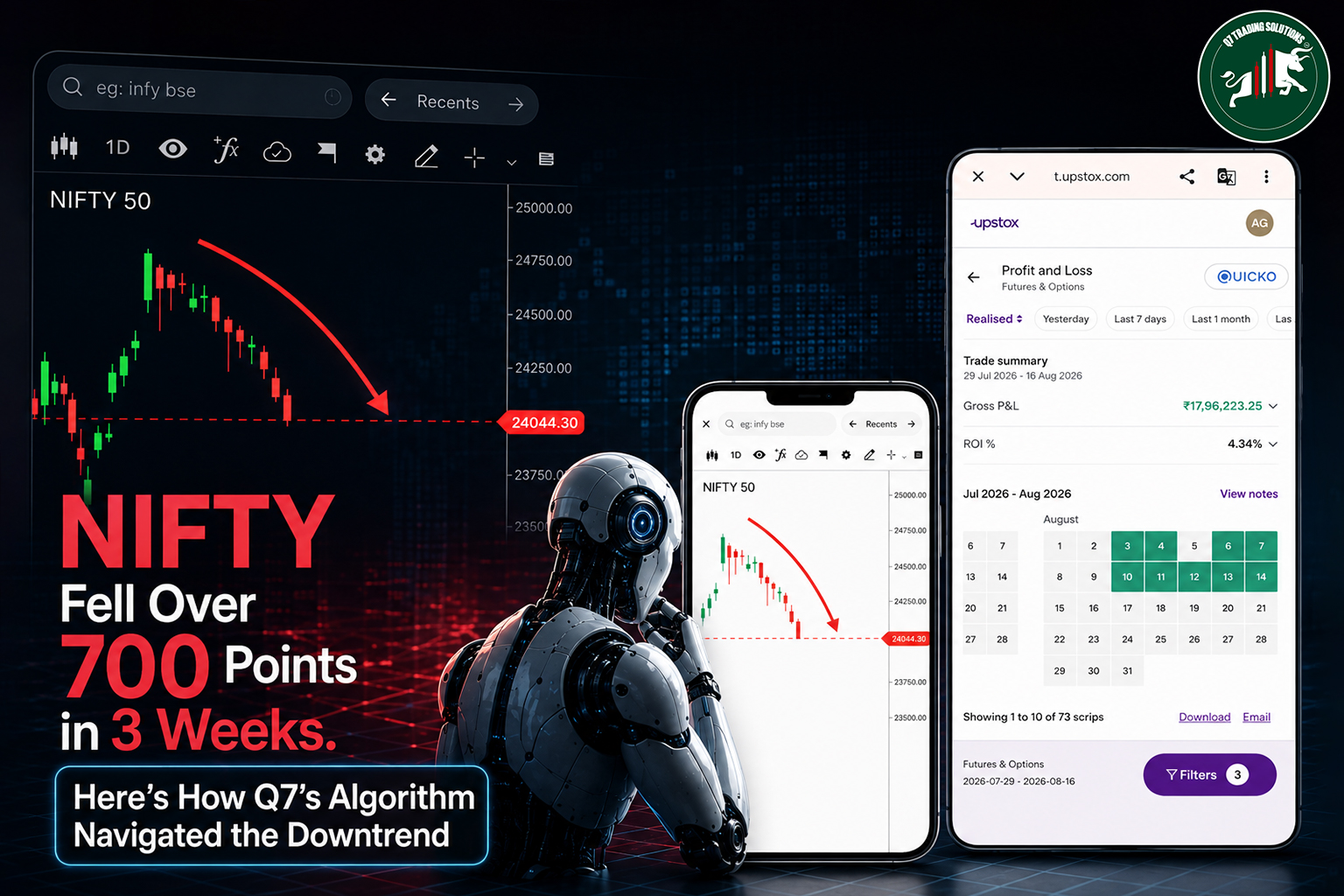
Over the past three weeks, NIFTY experienced a sustained downtrend, falling by more than 700 points during the period highlighted in Q7 Trading Solutions’ market analysis. With only a couple of positive sessions interrupting the broader weakness, the environment was particularly challenging for traders relying entirely on manual decision-making. But this is exactly where algorithmic trading can make a difference. Instead of depending on emotions, constant chart watching or trying to predict every market move, an algorithm can follow predefined rules and analyse market conditions systematically.
Q7 Trading Solutions recently shared a performance example showing how its algorithm navigated this challenging market environment.
NIFTY’s 3-Week Downtrend
The NIFTY 50 chart highlights the broader market weakness.
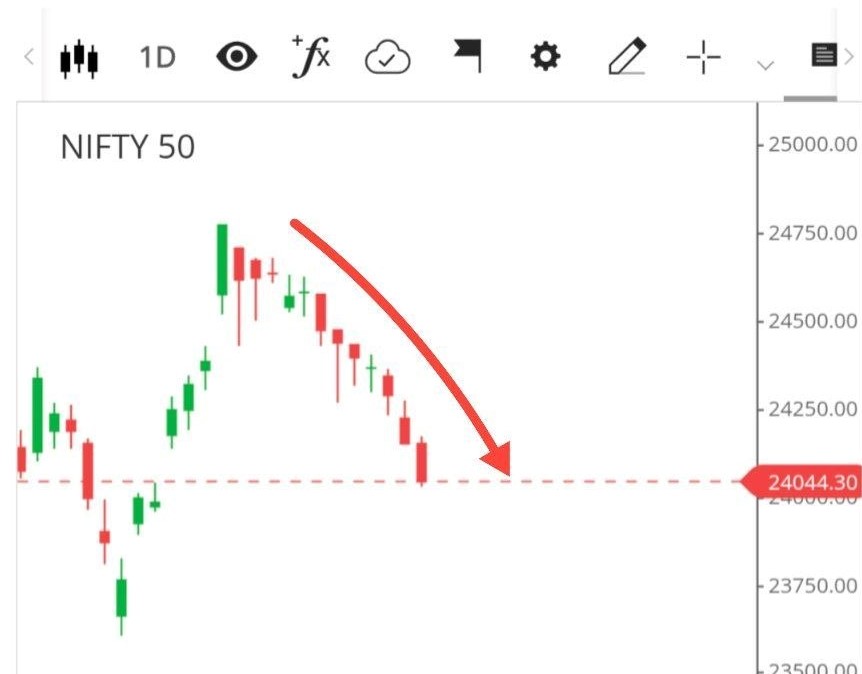
After trading around higher levels, the index entered a sustained decline. The chart shows a sequence of lower price movements, with the index eventually reaching the 24,000-area level shown in the shared chart.
For a manual trader, a prolonged decline can be psychologically difficult.
When markets remain weak for several sessions, traders may begin questioning their positions:
- Should I exit?
- Should I buy the dip?
- Is the market going to fall further?
- Should I hold my position?
- Is this a temporary correction or a larger trend?
These decisions become even harder when fear and uncertainty enter the process.
This is one of the areas where systematic trading approaches attempt to provide an advantage.
What Happens When the Market Keeps Falling?
A common misconception is that trading algorithms are designed only to make money when markets rise. That is not necessarily the case. Depending on the strategy and instruments being traded, algorithmic systems can be designed to respond to different market conditions. Instead of manually deciding what to do after every candle, an algorithm can monitor predefined conditions and execute according to its trading logic.
The potential advantages include:
- Faster execution
- Rule-based decision-making
- Reduced emotional interference
- Continuous market monitoring
- Consistent execution of predefined strategies
- Ability to process large amounts of market data
The important distinction is that an algorithm does not need to “feel” that the market is falling. It simply evaluates the conditions it has been designed to monitor.
Manual Trading vs Algorithmic Trading
Manual trading requires the trader to make decisions continuously. A trader may spend hours watching charts, interpreting indicators, following news and deciding when to enter or exit. During a prolonged downtrend, this can become emotionally exhausting. Algorithmic trading takes a different approach. Once the strategy and risk parameters are defined, the system can monitor the market and execute according to those rules without requiring the trader to manually intervene in every decision. This does not mean an algorithm is always right.
It means the decision-making process can be more systematic. For retail traders, that distinction can be important because emotional reactions are one of the biggest challenges associated with short-term trading.
The Q7 Algorithm Approach
Q7 Trading Solutions has built its offering around algorithmic and AI-assisted approaches to market analysis and automated trading. The company’s website describes its approach as emotion-free and automated, with no manual intervention required for its automated strategies. The objective is to allow the system to monitor market conditions while the trader does not have to remain glued to the screen throughout the trading session. Q7 has also published previous algorithm-focused case studies and AlgoStories showing how its systems responded to different market environments. The current example provides another opportunity to understand the concept.
The Result: Nearly ₹18 Lakh in Reported Gross P&L
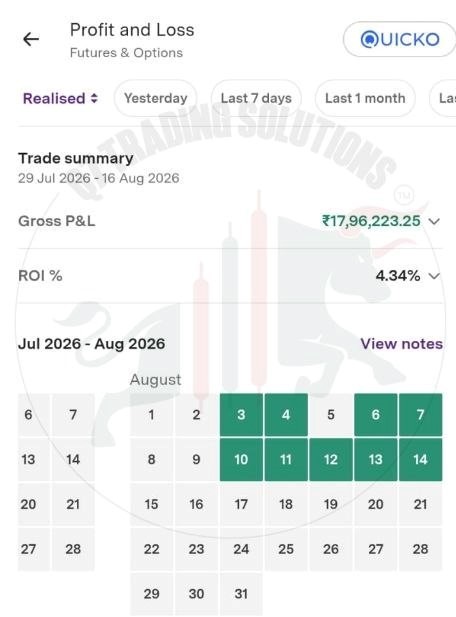
According to the screenshot, the displayed trading period runs from 29 July 2026 to 16 August 2026.
The screenshot reports:
- Gross P&L: ₹17,96,223.25
- ROI: 4.34%
- Period: 29 July 2026 – 16 August 2026
- Scripts shown: 73
The reported gross P&L is therefore close to ₹18 lakh despite the broader NIFTY decline highlighted in the accompanying chart.
This example illustrates the central idea behind algorithmic trading: a trader does not necessarily have to depend solely on the overall direction of the index.
Different strategies can seek opportunities based on specific market conditions.
Important note
The P&L shown above is a reported historical trading result shown in the supplied account screenshot. It should not be interpreted as a guarantee of future returns. Actual results can differ because of capital deployed, brokerage, slippage, taxes, market conditions, strategy settings and other factors.
Why Data Matters More Than Emotions
Imagine watching the market fall for three consecutive weeks. Even an experienced trader can experience uncertainty. Human beings naturally respond to losses emotionally. Fear can result in premature exits, while greed can encourage excessive risk-taking after a profitable trade. A systematic algorithm does not experience these emotions in the same way. It evaluates data according to its programmed logic. This is where the combination of data + algorithms + automation becomes relevant. Modern trading systems can process information much faster than a person manually scanning dozens of charts. That can potentially help identify opportunities and execute trades without allowing every market movement to trigger an emotional reaction.
Does Algo Trading Work in Every Market?
No. This is an important point. Algorithmic trading is not a magic formula that guarantees profits in every market condition. Every strategy has periods when it performs better and periods when it may struggle.
Markets can change because of:
- Unexpected economic announcements
- Global market movements
- Geopolitical events
- Sudden volatility
- Liquidity changes
- Interest-rate decisions
- Corporate news
- Changes in investor behaviour
A strategy that performs well in one market environment may produce different results in another. Therefore, proper risk management remains essential even when using an automated system.
Why Retail Traders Are Looking at Algo Trading
The rise of algorithmic trading has changed the competitive landscape of financial markets. Large institutions and professional trading firms have used automated systems for years. Retail traders now also have access to technology that can automate parts of the trading process. This does not mean a retail trader suddenly has the same infrastructure or resources as a large institutional trading firm. However, algorithmic platforms can potentially help retail participants improve execution discipline and reduce the impact of emotional decision-making. Q7 Trading Solutions specifically positions its algorithmic platform toward Indian retail traders rather than trying to replicate the infrastructure of large high-frequency trading firms.
The Bigger Lesson From the NIFTY Downtrend
The most important lesson from this example is not simply the reported P&L. It is the difference between reacting to the market and having a predefined system for responding to the market. When NIFTY falls for several weeks, a manual trader may constantly need to reassess the situation. An algorithm can instead evaluate the market against predefined rules. That can potentially make the trading process more disciplined and less dependent on emotions. This is one of the reasons algorithmic trading has become an increasingly important part of modern financial markets.
Can an Algorithm Guarantee Profit?
No. There is no legitimate trading system that can guarantee profits under every market condition. An algorithm can analyse data, follow rules and automate execution, but it cannot control the market. The right way to evaluate an algorithm is therefore to look at its methodology, historical performance, risk management, transparency and how it behaves across different market environments. Historical performance should always be treated as historical performance—not as a promise of future returns.
Q7 Trading Solutions: Making Trading More Systematic
The philosophy behind Q7 Trading Solutions is centred around using technology to make market participation more systematic. Its platform focuses on algorithmic trading and automated execution, with the broader objective of reducing emotional interference and allowing traders to spend less time manually monitoring the market.
Q7 also publishes algorithm-related case studies and market analyses through its blog, including previous examples of its algorithms navigating market volatility. For traders who are interested in exploring algorithmic trading, the key is to understand the strategy, risk and methodology rather than simply looking at one profitable period. A market decline of more than 700 points can be challenging for any trader.
The NIFTY chart shared by Q7 Trading Solutions demonstrates the kind of prolonged weakness that can put significant psychological pressure on manual traders. The accompanying account screenshot shows a reported gross P&L of approximately ₹17.96 lakh over the displayed period. Whether a strategy performs well in the future will depend on market conditions and the strategy’s ability to adapt to them. That is why the real value of algorithmic trading is not the promise of effortless profits.
It is the possibility of creating a systematic, rules-based and data-driven approach to the market. For traders interested in exploring Q7 Trading Solutions’ algorithmic trading solutions, learn more about the platform and its approach before making any trading decision. Trade with data. Trade with discipline. Manage your risk.
Frequently Asked Questions (FAQs)
Algo trading can monitor market conditions using predefined rules and execute trades systematically. Depending on the strategy, an algorithm may identify opportunities in different market environments, including periods of weakness. However, no strategy can guarantee profits.
The supplied trading-account screenshot reports a gross P&L of ₹17,96,223.25 for the displayed period from 29 July 2026 to 16 August 2026, with an ROI of 4.34%.
The Q7 market commentary accompanying the supplied chart describes NIFTY as falling by more than 700 points over the highlighted three-week period, with most sessions closing lower.
No. Algorithmic trading does not guarantee profits. Algorithms operate according to predefined strategies and can experience losses when market conditions change or when trading signals fail.
Manual trading requires a trader to analyse the market and make trading decisions themselves. Algorithmic trading uses predefined rules and technology to analyse market conditions and automate trading decisions and execution.
Retail traders may use algorithmic trading to reduce emotional decision-making, automate execution, monitor markets systematically and apply predefined trading rules without manually watching charts continuously.
No. The ₹17.96 lakh figure is a historical result shown in the supplied screenshot. Past performance does not guarantee future results, and individual outcomes can vary based on capital, strategy, costs and market conditions.