How can data analysis help identify a market bottom?
Data-driven analysis can help identify potential bottom formations by studying price action, market behaviour, momentum and historical patterns. However, no analysis can guarantee a market reversal or investment profit.
Table of Contents
- Chapter 1: What Happened in the Market?
- Chapter 2: Why Identifying a Bottom Is Difficult
- Chapter 3: The Role of Data in Market Analysis
- Chapter 4: How AI and Algorithms Are Changing Trading
- Chapter 5: The 9:35 AM Reversal: What Can Traders Learn?
- Chapter 6: Q7 Trading Solutions and Data-Driven Analysis
- Chapter 7: Can AI Predict the Stock Market?
- Chapter 8: Why Risk Management Still Matters
- Chapter 9: The Future of AI-Based Trading
- Chapter 10: Frequently Asked Questions (FAQs)
Financial markets can change direction rapidly. A sharp decline can create fear among investors, while a sudden reversal can leave traders wondering whether the market has already formed a short-term bottom.
This is where data-driven market analysis becomes increasingly important.
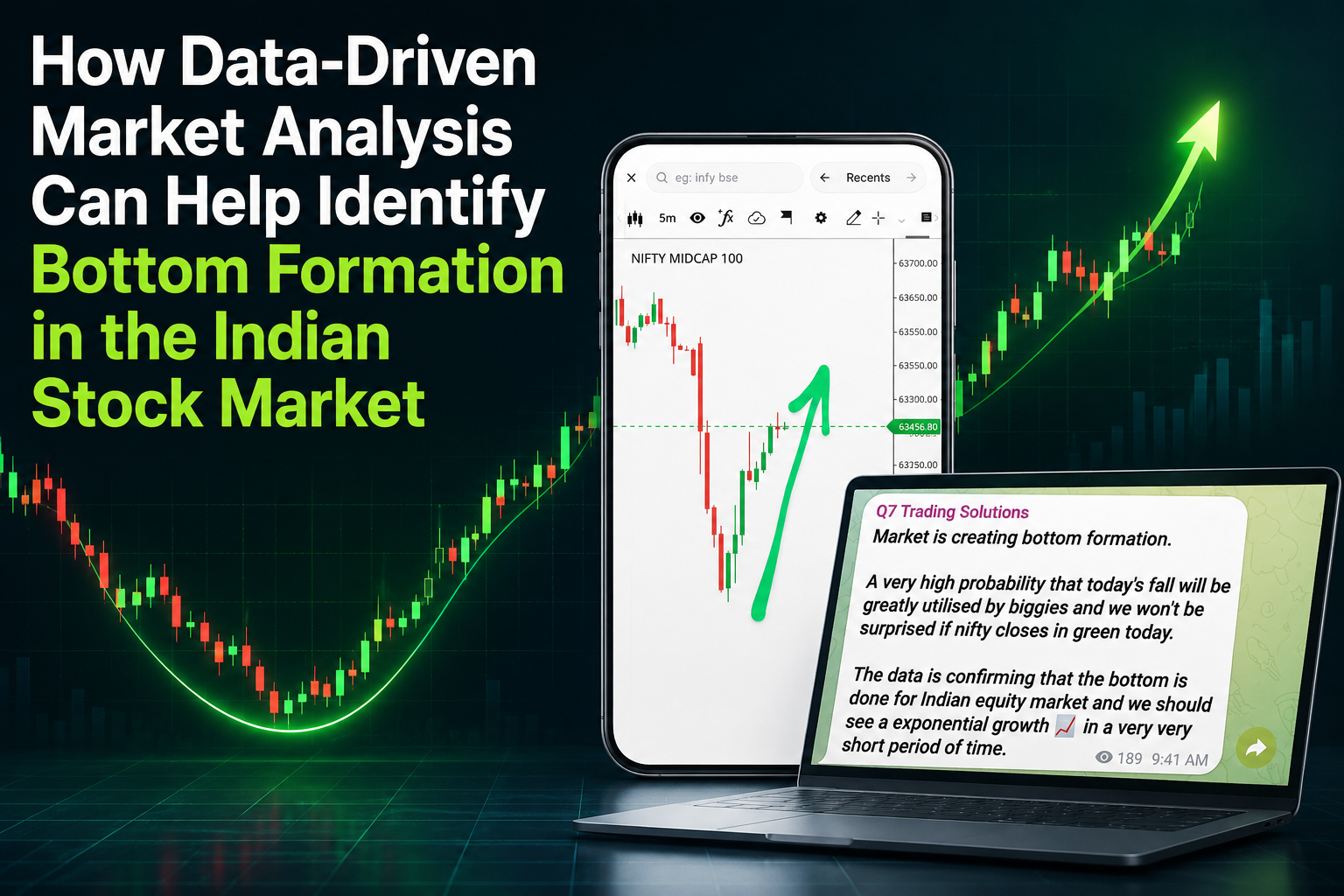
A recent market observation shared by Q7 Trading Solutions provides an interesting example. At around 9:41 AM, Q7 Trading Solutions identified that the market was potentially creating a bottom formation and suggested that the day’s weakness could be utilised by larger market participants.
The subsequent price action shown in the NIFTY Midcap 100 chart highlights a reversal that began around the 9:35 AM candle, followed by a recovery in price.
The key lesson is not simply whether a single market call was correct. The bigger lesson is how structured data analysis can help traders interpret rapidly changing market conditions.
What Happened in the Market?
The shared market chart shows the NIFTY Midcap 100 moving lower before finding support and beginning a recovery. According to the market commentary shared by Q7 Trading Solutions, the data indicated that the market was developing a potential bottom formation. The observation was made around 9:41 AM, while the chart subsequently showed a reversal beginning around the 9:35 AM candle.
This type of market behaviour demonstrates why timing and data interpretation can matter significantly in short-term trading.
A market may appear weak when viewed only through the lens of a sharp decline. However, underlying price behaviour can sometimes provide early indications that selling pressure is weakening.
Why Identifying a Bottom Is Difficult
Finding a market bottom is one of the most challenging tasks in trading.
When prices fall sharply, investors often become emotional. Fear can encourage traders to exit positions at unfavourable levels, while uncertainty can prevent them from recognising a potential recovery. At the same time, attempting to predict the exact bottom manually can be extremely difficult.
Markets are influenced by numerous factors, including:
- Price and volume behaviour
- Global market movements
- Institutional activity
- Economic data
- Interest rates
- Corporate earnings
- Investor sentiment
- Liquidity
- News and geopolitical developments
- Technical market structure
Because these variables interact continuously, relying on a single indicator may not be sufficient. This is one reason why systematic and data-driven approaches have become increasingly relevant in modern trading.
The Role of Data in Market Analysis
Data provides traders with an opportunity to look beyond emotion.
Instead of asking only, “Is the market falling?”, a data-driven system can examine additional questions:
- Is selling momentum increasing or decreasing?
- Is the market approaching a historically important level?
- Are buyers beginning to appear?
- Has price behaviour changed from the previous trend?
- Are multiple signals pointing toward a potential reversal?
- How has the market behaved in similar situations previously?
When several independent signals begin to align, traders may receive a more structured view of the market.
This does not mean that a reversal is guaranteed.
Rather, the objective is to identify probability-based opportunities and manage risk accordingly.
How AI and Algorithms Are Changing Trading
Technology has significantly changed financial market analysis. Traditional manual analysis requires traders to observe charts, interpret indicators and compare market conditions themselves. Algorithms can process large amounts of market data much faster than a human trader.
AI-assisted systems can potentially help identify patterns across:
- Historical price data
- Intraday price movements
- Market momentum
- Volatility
- Trading behaviour
- Technical indicators
- Multiple timeframes
The major advantage is speed and consistency. A machine does not experience fear when prices fall sharply or excitement when markets suddenly rise. It can evaluate predefined conditions without the same emotional pressures faced by human traders. However, AI and algorithms are not infallible. Models depend on data, methodology, assumptions and market conditions. A strategy that performs well in one environment can behave differently in another. Therefore, technology should be viewed as a decision-support and analysis tool rather than a guarantee of market success.
The 9:35 AM Reversal: What Can Traders Learn?
The chart shared with the market commentary highlights an important concept.
The market experienced a decline before reversing from lower levels. The reversal became visible around the 9:35 AM candle, while the market commentary identifying a potential bottom formation was shared around 9:41 AM. For traders, the important takeaway is the relationship between data, price action and timing.
A reversal does not become meaningful simply because a candle turns green. Traders need to examine the broader structure surrounding that move.
Questions worth considering include:
- Where did the decline begin?
- How quickly did the market fall?
- Where did buyers enter?
- Did selling pressure reduce?
- Did subsequent candles confirm the reversal?
- Was the move supported by broader market conditions?
This type of structured analysis can be more useful than reacting to one isolated candle.
Q7 Trading Solutions and Data-Driven Analysis
Q7 Trading Solutions focuses on using technology and algorithmic approaches to analyse financial markets.
The company’s market commentary highlights the growing role of algorithmic analysis and AI-assisted technology in understanding market behaviour.
According to the material shared by Q7 Trading Solutions, its approach has evolved over several years with the objective of helping clients navigate different market conditions through systematic analysis.
The central idea is straightforward:
Use data to make decisions instead of allowing emotions to make decisions for you.
For traders, this can mean using technology to monitor market conditions while maintaining appropriate risk-management practices.
Can AI Predict the Stock Market?
AI cannot reliably predict every future market movement.
Financial markets are complex systems influenced by information that can change unexpectedly. Even sophisticated models can generate incorrect signals.
What AI can potentially do is identify patterns, process information quickly and generate probability-based signals based on predefined models and available data. That distinction is important. The objective should not be to believe that an algorithm can predict every market movement. Instead, traders can use technology to improve the consistency and speed of their analysis.
Why Risk Management Still Matters
Even the strongest-looking market signal can fail.
A potential bottom formation may be followed by another decline. A bullish reversal may turn into a false breakout. Unexpected news can completely change market conditions. Therefore, data analysis should always be combined with risk management.
Traders should consider:
- Position sizing
- Stop-loss levels
- Portfolio exposure
- Risk-reward ratios
- Market volatility
- Trading timeframe
- Overall investment objectives
No algorithm can eliminate market risk. The purpose of systematic analysis is to potentially improve the quality of decision-making, not to remove uncertainty from financial markets.
The Future of AI-Based Trading
The combination of financial markets, algorithms and artificial intelligence is likely to become increasingly important.
As computing power increases and more market data becomes available, traders and financial professionals can develop increasingly sophisticated methods of analysing market behaviour. The future of trading may therefore involve a combination of:
Human judgement + Data + Algorithms + AI + Risk Management
Human judgement remains important because market conditions can change in ways that historical data cannot fully capture. Technology provides speed and scale. Risk management provides protection when assumptions prove incorrect. Together, these components can create a more disciplined trading framework.
The NIFTY Midcap 100 example shared by Q7 Trading Solutions offers a useful lesson about the importance of observing market data rather than reacting emotionally to short-term volatility. The market can look extremely weak immediately before a recovery. Similarly, a seemingly strong reversal can fail. This is why traders should focus on probabilities, confirmation and risk management rather than certainty.
The future of trading is increasingly data-driven. AI and algorithmic systems can help traders process information faster and identify patterns that may be difficult to observe manually. But technology is most effective when it is combined with discipline and responsible risk management.
Q7 Trading Solutions believes that data-driven analysis can give traders a structured approach to navigating changing market conditions.
For more information about Q7 Trading Solutions and its algorithmic market-analysis solutions, visit q7tradingsolutions.com.
Frequently Asked Questions (FAQs)
AI and data-driven systems can analyse large amounts of market information, including price movements, momentum, historical patterns and other indicators, to identify conditions that may indicate a potential bottom formation. However, no system can guarantee that a market reversal will occur.
Q7 Trading Solutions identified a potential bottom formation in its 9:41 AM market commentary. The accompanying chart showed the reversal beginning around the 9:35 AM candle, highlighting how data-driven analysis can help identify changing market conditions.
AI cannot predict every market reversal with certainty. It can process market data and identify probability-based patterns, but unexpected news, volatility and changing market conditions can cause any trading signal to fail.
Algorithmic trading uses predefined rules, data and technology to analyse markets and execute trading decisions systematically. It can reduce emotional interference and improve consistency, but it does not eliminate market risk.
No trading system can guarantee profits. Q7 Trading Solutions uses algorithmic and data-driven approaches to help traders analyse and respond to market conditions, but trading and investing always involve risk.
Data allows traders and algorithms to analyse market behaviour systematically rather than relying entirely on emotions or intuition. Large datasets can also help identify patterns that may be difficult to evaluate manually.