What is emotional trading?
Emotional trading is the practice of making trading decisions based primarily on feelings such as fear, greed, FOMO, frustration or impatience rather than following a predefined strategy and risk-management plan. Algorithmic trading can help reduce emotional interference by executing predefined rules systematically.
Table of Contents
- Chapter 1: A Real Conversation That Says It All
- Chapter 2: Emotional Trading: The Hidden Enemy)
- Chapter 3: The Problem With Trading Without a Process
- Chapter 4: Why Traders Keep Changing Their Strategy
- Chapter 5: When Comparison Becomes the Problem
- Chapter 6: The Psychology Behind Quitting a Trading System
- Chapter 7: Algorithmic Trading Changes the Process
- Chapter 8: The Importance of Patience in Algo Trading
- Chapter 9: The Real Freedom Is Breaking the Emotional Trading Cycle
- Chapter 10: Frequently Asked Questions
Trading is often presented as a game of charts, indicators, strategies and market predictions. But there is another factor that can determine a trader’s journey just as strongly: psychology.
A trader may have access to a good strategy, a sophisticated system and a clearly defined process, yet still struggle to achieve consistency because emotions take control at the wrong moment. Fear, greed, impatience, FOMO, frustration and the constant comparison with other traders can push people away from the very system they initially trusted.
One real conversation with a Q7 client demonstrates this emotional rollercoaster better than any textbook could.
A Real Conversation That Says It All
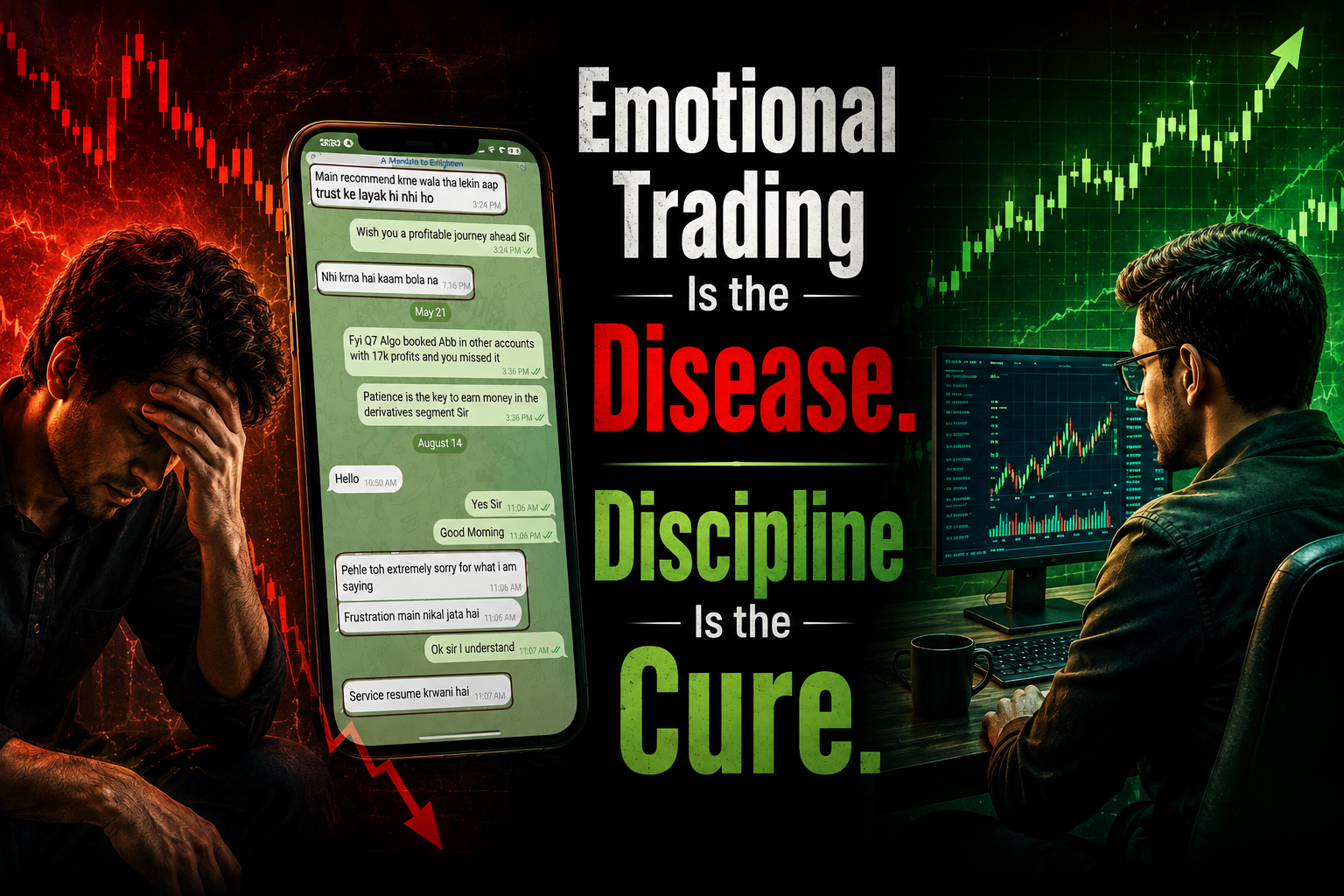
The conversation shared alongside this article captures something that happens frequently in the trading world. A trader initially questions the system, becomes frustrated, watches other accounts, notices different profit numbers and eventually wants to stop the service.
Then comes the familiar cycle: doubt, frustration, comparison, impatience and the temptation to return to the old way of trading. This is not necessarily a problem with the market. It can be a problem with the process and the trader’s response to the process.
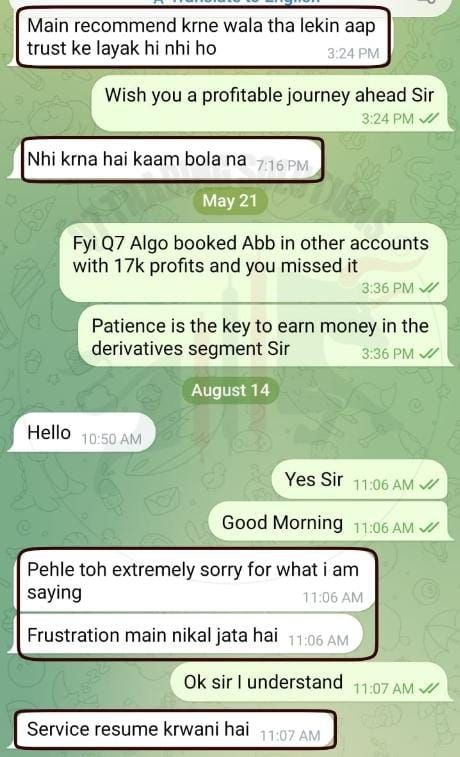 The screenshot is a practical example of how difficult it can be for a trader to remain patient when results do not immediately match expectations.
Emotional Trading: The Hidden Enemy
Emotional trading happens when decisions are influenced more by feelings than by a predefined trading plan.
A trader may enter because everyone else appears to be making money. They may exit because a position temporarily moves against them. They may increase their position after a loss because they want to recover quickly. They may abandon a strategy after seeing another trader post better results.
These decisions can feel completely logical in the moment. But when repeated over time, they can create an inconsistent trading process. The trader is no longer following a system. The trader is reacting to emotions.
The Problem With Trading Without a Process
Many retail traders begin their journey by depending heavily on buy and sell calls, tips or short-term market opinions. Instead of having predefined entry conditions, exit rules, position sizing and risk-management parameters, the decision often becomes:
“Should I buy?”
or
“Should I sell?”
The bigger question should be:
“What is my trading process?”
A structured process defines what should happen before the trade, during the trade and after the trade. Without that structure, every market movement can become a reason to change direction.
Why Traders Keep Changing Their Strategy
One of the biggest challenges traders face is expecting immediate results from a strategy. A system may experience a period of drawdown or several trades that do not work as expected. The trader begins questioning it. Then they see someone else posting profits. Suddenly, their own strategy appears slow. They start thinking about switching systems, closing the algorithm or returning to manual trading.
This creates a dangerous cycle:
Trade → Doubt → Compare → Exit System → Manual Trade → Emotional Decision → Loss → Regret → Repeat.
The strategy may never receive enough time for its process to play out.
When Comparison Becomes the Problem
Social media and trading communities have made comparison easier than ever. One trader posts a profitable trade, another shares a screenshot showing a large gain, and someone else claims they made significant returns in a single day. Meanwhile, your own account may be experiencing a temporary drawdown, leading to the natural question: “Why am I not making what they are making?” But trading cannot be judged by comparing one account’s daily result with another person’s screenshot. Different strategies have different risk profiles, positions, time horizons, and market exposure. A disciplined trader should evaluate a system based on its overall methodology, risk management, and long-term performance, rather than on one isolated day’s result.
The Psychology Behind Quitting a Trading System
Imagine starting a healthy lifestyle. You begin eating better, exercising regularly, and avoiding habits that were damaging your health. After a few days, you look in the mirror and see no dramatic transformation, so you decide the lifestyle is not working and return to your old habits. Trading psychology can work in exactly the same way. A systematic approach requires patience because the benefits of discipline may not appear every single day. There can be losing trades, periods of inactivity, and temporary drawdowns. The temptation to abandon the process can become strongest precisely when patience is required the most.
Algorithmic Trading Changes the Process
Algorithmic trading introduces a different approach. Instead of relying on emotions and moment-to-moment decisions, a trading strategy can be converted into predefined rules and systematically executed through technology. The objective is not to predict every market movement, but to follow a defined process. An algorithm does not feel excitement when another trader posts a profit, experience FOMO because a stock is suddenly moving, or become frustrated after one losing trade. It simply follows the rules it has been designed to follow.
The Importance of Patience in Algo Trading
Algorithmic trading does not mean every trade will be profitable, every day will end in green, or market risk will disappear. What it can provide is consistency in following predefined rules. That consistency is important because a strategy cannot be properly evaluated if the trader repeatedly switches it off whenever short-term results become uncomfortable.
Trading Discipline Is Like a Healthy Lifestyle
Building financial discipline is similar to building physical discipline. Going to the gym for three days does not transform your health. Eating clean for one week does not create a permanent lifestyle. Likewise, following an algorithm for a few days and then abandoning it because another account shows higher returns does not create a disciplined trading process. Consistency matters. The goal is not to feel comfortable every single day. The goal is to follow a process that has been designed with defined rules and appropriate risk management.
Change the Process to Change the Result
If a trader continues making decisions based on fear, greed, tips, FOMO and short-term comparisons, changing the stock or indicator may not solve the underlying problem. Sometimes the process itself needs to change.
Instead of asking:
“Which trade will make me money today?”
the better question is:
“What system can help me make decisions consistently over time?”
That shift—from individual trades to a structured process—is one of the most important changes a trader can make.
Financial Health Requires Discipline
Financial health is not built through one spectacular trade. It is built through risk management, consistency, patience and disciplined decision-making. Algorithmic trading can help reduce some of the emotional interference associated with manual execution, but the trader still has an important role to play. Understanding the strategy, selecting appropriate risk, monitoring the system and avoiding impulsive interference remain essential. Technology can automate execution.
Discipline still belongs to the trader.
The Real Freedom Is Breaking the Emotional Trading Cycle
The biggest benefit of a systematic trading approach may not simply be automation. It can be the ability to step away from the emotional cycle of constantly asking:
“Should I enter?”
“Should I exit?”
“Why did someone else make more money?”
“Should I stop the system?”
When a predefined strategy is being followed systematically, traders can focus more on the overall process rather than reacting to every individual market movement.
Key Takeaways for Traders
The real battle in trading is often not between the trader and the market. It is between the trader and their own emotions. A strategy can only work according to its design when it is given the opportunity to operate consistently. Constantly switching between systems, comparing daily results and reacting emotionally to temporary losses can undermine even a well-defined trading process. Algorithmic trading can bring structure, automation and consistency to execution, but it is not a shortcut to guaranteed profits. The objective should be simple:
Build a strategy. Define the rules. Manage the risk. Stay disciplined. Give the process time.
At Q7 Trading Solutions, the focus is on helping traders move away from impulsive, emotion-driven decisions toward a more systematic approach to trading. Because if you want a different result, you often need to start by changing the process.
Frequently Asked Questions
Emotional trading occurs when traders make decisions based on fear, greed, FOMO, frustration or other emotions instead of following a predefined trading strategy and risk-management plan.
Traders may abandon a system because of temporary losses, drawdowns, impatience or comparisons with other traders. Seeing someone else report higher short-term profits can create doubt and encourage traders to switch strategies before their own system has had enough time to perform.
Algorithmic trading can reduce emotional interference in trade execution because predefined rules are followed systematically rather than being changed based on moment-to-moment emotions. However, traders still need discipline and appropriate risk management.
No. Algorithmic trading does not guarantee profits or eliminate market losses. Every strategy carries risk, and performance can vary across different market conditions.
A systematic strategy may experience losing trades, drawdowns or periods of lower performance. Constantly interfering with the system can prevent traders from evaluating the strategy over an appropriate period. Patience allows the predefined process to operate according to its design.
One common mistake is treating an algorithm as a guaranteed-profit machine and switching it off whenever short-term results become uncomfortable. A better approach is to understand the strategy, its risks and expected behaviour before deciding whether it is suitable.