What is driving India’s shipbuilding boom?
India’s shipbuilding opportunity is being driven by a combination of government support, a large defence pipeline, growing demand for commercial vessels, and the transition toward green shipping. The government’s ₹69,725 crore support package, including a ₹25,000 crore Maritime Development Fund, aims to make financing cheaper and strengthen India’s shipbuilding ecosystem.
Table of Contents
- Chapter 1: India’s Shipbuilding Opportunity
- Chapter 2: Why Is India’s Shipbuilding Sector Gaining Attention?
- Chapter 3: Three Trends Driving the Opportunity
- Chapter 4: Key Shipyards to Watch
- Chapter 5: The Risks: Why the Story Isn’t Straightforward
- Chapter 6: Bottom Line: Opportunity Meets Execution
- Frequently Asked Questions (FAQs)
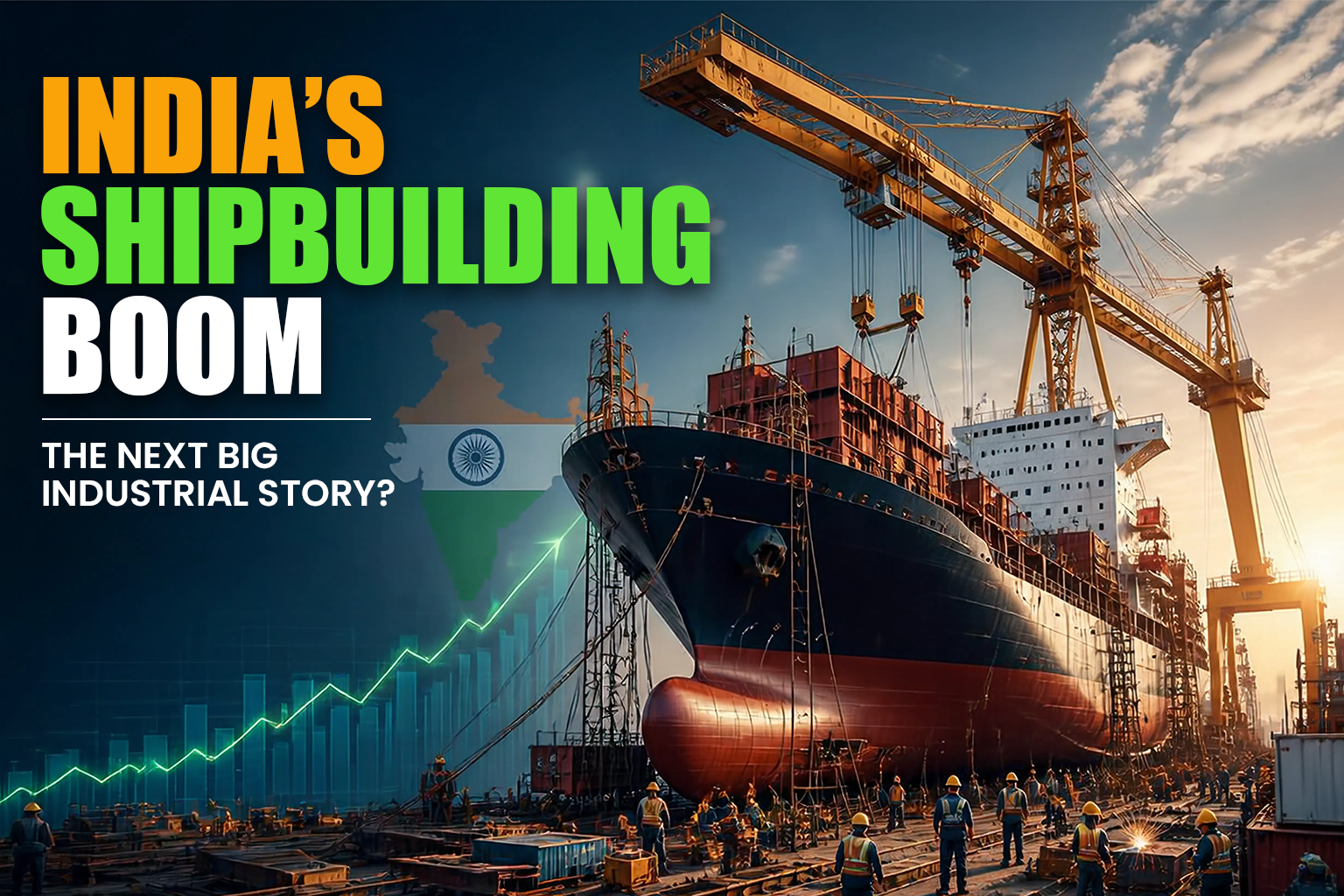
India’s Shipbuilding Boom: The Next Big Industrial Story?
India moves ~95% of its trade by sea, yet accounts for less than 1% of global shipbuilding. That huge gap is exactly where the opportunity lies.
The government is now trying to change this with a ₹69,725 crore support package, including subsidies and a ₹25,000 crore Maritime Development Fund to make financing cheaper.
1. India’s Shipbuilding Opportunity
India moves around 95% of its trade by sea, yet accounts for less than 1% of global shipbuilding.
The government is trying to change this with a ₹69,725 crore support package, including subsidies and a ₹25,000 crore Maritime Development Fund.
This creates an opportunity for India to expand its domestic shipbuilding capacity and strengthen its position in the global maritime industry.
2. Why Is India’s Shipbuilding Sector Gaining Attention?
India’s shipbuilding sector is attracting attention because of the significant gap between the country’s maritime trade and its share of global shipbuilding.
Around 95% of India’s trade moves by sea, while the country contributes less than 1% of global shipbuilding. This gap highlights the potential for India to build a larger domestic shipbuilding industry.
The government’s ₹69,725 crore support package, together with the ₹25,000 crore Maritime Development Fund, is intended to support the expansion of domestic shipbuilding and make financing more accessible.
If these measures translate into greater capacity and stronger execution, Indian shipyards could participate more meaningfully in the growing demand for commercial, defence, and next-generation vessels.
3. Three Trends Driving the Opportunity
Defence: A Large Naval Pipeline
India has a naval pipeline worth more than ₹1.5 lakh crore. The pipeline includes major defence projects such as submarines and destroyers.
This creates a substantial opportunity for domestic shipyards with the capabilities required to execute large naval projects.
Commercial: Building More Ships Domestically
India wants to build more ships domestically that it currently imports.
Increasing domestic construction could create opportunities for Indian shipyards while reducing dependence on overseas shipbuilding capacity.
Green Shipping: A Potential Replacement Cycle
The transition toward greener shipping could create another source of demand.
Methanol, ammonia, and other next-generation vessel technologies could lead to a fresh replacement cycle as shipping companies look toward newer and cleaner vessels.
4. Key Shipyards to Watch
Mazagon Dock — Defence Heavyweight
Mazagon Dock has an orderbook of around ₹40,000 crore and could potentially receive another ₹45,000+ crore from P75I (Project 75 India).
Its position in major defence shipbuilding projects gives it significant exposure to India’s naval expansion.
GRSE — The Growth Machine
GRSE has recorded around 40% three-year revenue CAGR and 43% ROCE.
Among the major listed shipyards covered in the report, GRSE has the lowest market-cap-to-orderbook ratio.
Cochin Shipyard — The Diversification Play
Cochin Shipyard is diversified across ship repair, commercial vessels, and dredgers.
The company also has a partnership with HD Hyundai.
At around 66× P/E, the valuation leaves little room for disappointment.
KMEW — Smaller, Faster and Riskier
KMEW has an orderbook of around 6.4× FY26 revenue.
Its smaller profile and large orderbook relative to FY26 revenue provide significant growth potential, but the smaller-company profile also comes with higher risk.
5. The Risks: Why the Story Isn’t Straightforward
India’s shipbuilding story is not simply a case of buying every shipbuilding stock.
There are several risks that investors need to consider, including:
- Policy execution: Government support needs to translate into actual capacity expansion and projects.
- Financing: Shipbuilding requires significant capital, making financing conditions important for the sector.
- China’s cost advantage: Chinese shipbuilders continue to have a significant cost advantage in the global market.
- Project delays: Large shipbuilding projects can face delays, affecting the timing of revenue recognition.
- High valuations: Some shipbuilding companies are already valued at high multiples, leaving less room for execution disappointments.
An orderbook provides revenue visibility, but it does not guarantee when that revenue will be recognized.
Execution and revenue recognition therefore remain important factors when assessing shipbuilding companies.
6. Bottom Line: Opportunity Meets Execution
India’s shipbuilding story is real—but the key is identifying shipyards that can convert policy support and orderbooks into capacity, profits, and cash flow.
Three major trends are driving the opportunity:
- Defence: A large naval pipeline involving submarines, destroyers, and other defence vessels.
- Commercial shipbuilding: An effort to build more of the ships India currently imports domestically.
- Green shipping: Potential demand from the transition toward methanol, ammonia, and other next-generation vessels.
At the same time, investors need to consider policy execution, financing requirements, China’s cost advantage, project delays, and high valuations.
The central theme is therefore not simply the growth of India’s shipbuilding industry, but the ability of individual shipyards to execute projects and turn large orderbooks into sustainable financial performance.
Frequently Asked Questions
India moves around 95% of its trade by sea, but accounts for less than 1% of global shipbuilding. This gap creates an opportunity for India to expand its domestic shipbuilding industry.
The government has announced a ₹69,725 crore support package, including subsidies and a ₹25,000 crore Maritime Development Fund. The package is intended to support the domestic shipbuilding ecosystem and make financing cheaper.
The three major trends are defence, commercial shipbuilding, and green shipping.
The defence opportunity is supported by a naval pipeline of more than ₹1.5 lakh crore. Commercial shipbuilding is supported by efforts to build more ships domestically that India currently imports. Green shipping could create a replacement cycle involving methanol, ammonia, and other next-generation vessels.
The report highlights Mazagon Dock, GRSE, Cochin Shipyard, and KMEW.
Mazagon Dock is highlighted for its defence exposure, GRSE for its growth characteristics, Cochin Shipyard for diversification, and KMEW as a smaller company with a large orderbook relative to FY26 revenue and consequently higher risk.
The major risks include policy execution, financing requirements, China’s cost advantage, project delays, and high valuations.
No. An orderbook provides revenue visibility, but it does not guarantee the timing of future revenue. Project execution and revenue recognition remain important.
No. The report emphasizes that the opportunity needs to be considered alongside execution. The focus is on identifying shipyards that can convert policy support and orderbooks into capacity, profits, and cash flow.