What is RAINMUMBAI and how does it work?
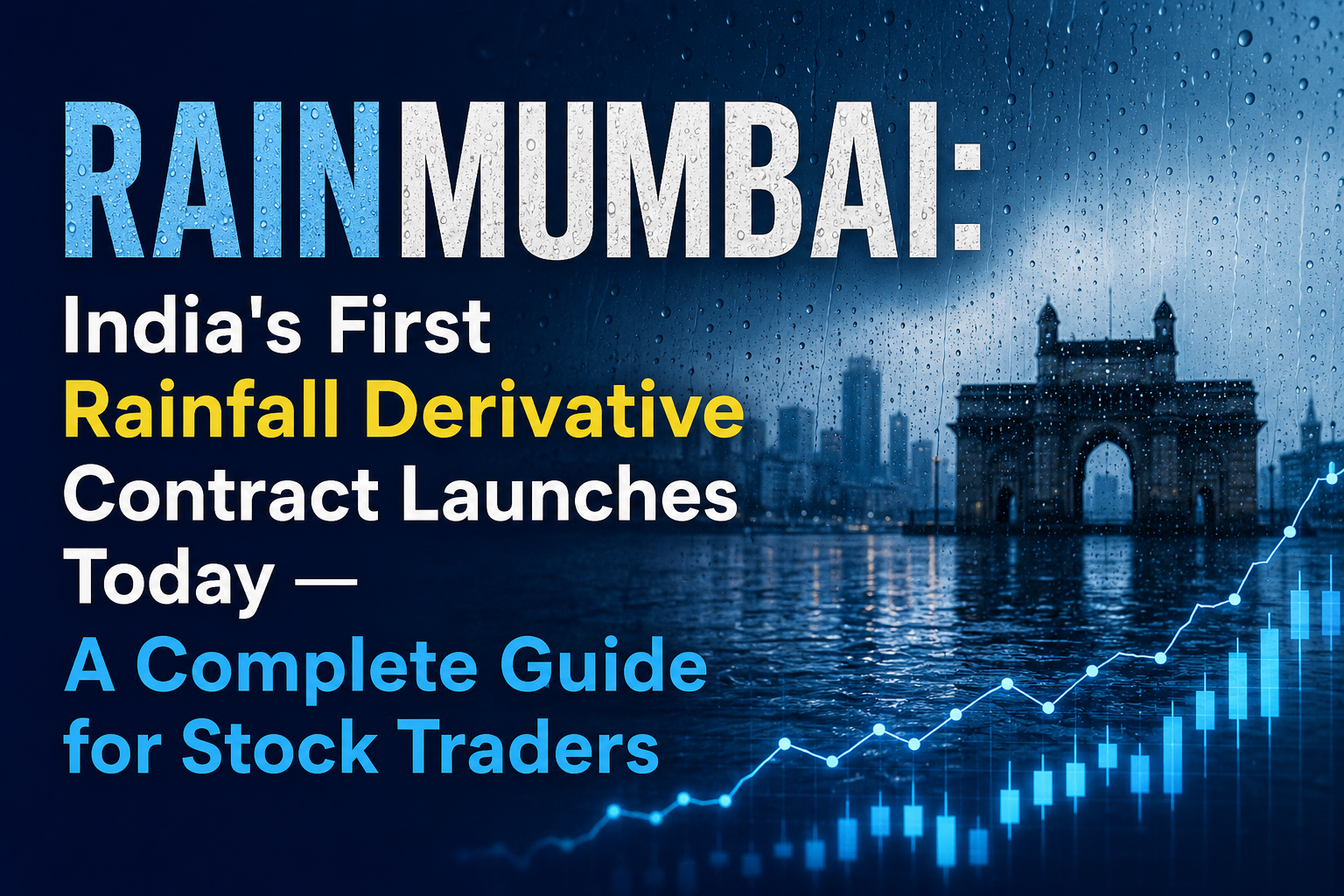
RAINMUMBAI is India’s first SEBI-approved, exchange-traded weather derivatives contract, launched by NCDEX on May 29, 2026. It is a cash-settled futures contract that tracks the Cumulative Deviation Rainfall (CDR) — the difference between Mumbai’s actual monsoon rainfall and its 30-year Long Period Average (LPA) of 2,206.7 mm. The contract has a tick size of 1 mm, a lot multiplier of ₹50 per mm, and maximum order size of 50 lots. Four monthly contracts are available for June, July, August, and September. Settlement is fully automatic based on IMD rainfall data, with no physical delivery.
Table of Contents
- Chapter 1: Why Does a Rainfall Futures Contract Even Exist?
- Chapter 2: What Exactly Is RAINMUMBAI? A Plain English Explanation
- Chapter 3: How the CDR Index Works
- Chapter 4: Contract Specifications: Everything a Trader Needs to Know
- Chapter 5: Settlement Example (So You Understand the P&L)
- Chapter 6: Who Is This Contract Designed For?
- Chapter 7: Primary Users: Hedgers with Genuine Weather Exposure
- Chapter 8: Secondary Users: Liquidity Providers and Proprietary Traders
- Chapter 9: From a Stock Trader's Lens: How This Changes Your Toolkit
- Chapter 10: The Timing Could Not Be More Relevant: Monsoon 2026 Is Below Normal
- Chapter 11: How RAINMUMBAI Differs from Traditional Crop Insurance
- Chapter 12: What Global Weather Derivatives Markets Teach Us
- Chapter 13: Risks Traders Need to Understand Before They Trade
- Chapter 14: How to Access RAINMUMBAI as a Trader
- Chapter 15: The Bigger Picture: What RAINMUMBAI Means for Indian Markets
India just crossed a major milestone in financial market history, and most traders haven’t fully understood what it means yet.
Today, May 29, 2026, the National Commodity and Derivatives Exchange (NCDEX) officially begins trading RAINMUMBAI — India’s first ever SEBI-approved, exchange-traded weather derivatives contract. For the first time in the country’s history, you can now take a position on how much it rains in Mumbai — and profit from being right.
But hold on — before you start thinking this is some novelty gimmick, let me be direct with you. This is a serious financial instrument, developed in collaboration with IIT Bombay, backed by India Meteorological Department (IMD) data, and approved by SEBI. It is built on the same principle that has powered a multi-billion-dollar global weather derivatives industry for over two decades. India has just joined that club.
Let’s break it down completely — what it is, how it works, who it’s designed for, how traders can use it, and what the broader implications are for Indian markets.
Why Does a Rainfall Futures Contract Even Exist?
Before we get into contract specs, it’s important to understand why this instrument was created — because it answers the question of who actually needs it.
Here’s the fundamental problem: monsoon rainfall is India’s most important economic variable that nobody could hedge against in an organised, transparent way.
Consider these facts:
- The monsoon delivers nearly 70% of India’s annual rainfall and supports agriculture, which contributes approximately 18% to India’s ~$4 trillion GDP.
- More than 50% of Indian agriculture depends on rainwater irrigation.
- Industries from FMCG to power to construction have direct revenue correlation with monsoon performance.
- In 2026, the IMD has forecast a below-normal monsoon at 92% of the Long Period Average (LPA) — the lowest first long-range forecast in at least 25 years.
And yet, until today, if you were a fertiliser company worried about weak monsoon demand, or an umbrella manufacturer nervous about excess rain, or an irrigation equipment firm that desperately needed a dry season — you had zero exchange-traded instrument to hedge that risk.
You could buy insurance, yes. But insurance requires proving actual physical damage, involves claim assessments, delays, and paperwork. Weather derivatives operate differently — and that difference is transformational.
What Exactly Is RAINMUMBAI? A Plain English Explanation
RAINMUMBAI is a parametric cash-settled futures contract listed on NCDEX under the ticker symbol — you guessed it — RAINMUMBAI.
Here’s the simplest way to understand it:
The underlying asset is not a commodity or a stock price. It is the deviation of Mumbai’s actual rainfall from its historical average.
That deviation is measured through an index called the Cumulative Deviation Rainfall (CDR).
How the CDR Index Works
Every day during the monsoon months (June to September), the CDR value is updated based on IMD rainfall readings from two weather stations in Mumbai: Santacruz and Colaba.
The formula is straightforward:
CDR = Actual cumulative rainfall (mm) − Long Period Average (LPA) cumulative rainfall (mm)
The LPA benchmark for Mumbai’s full monsoon season is 2,206.7 mm (based on 30 years of data from 1991 to 2020).
- If it rains more than the LPA, CDR is positive (excess rainfall)
- If it rains less than the LPA, CDR is negative (rainfall deficit)
The futures contract price moves with this CDR value. Each 1 mm change in CDR is worth ₹50 per lot in contract P&L.
Think of it like this: the contract is priced in millimetres of rain, not rupees of a commodity.
Contract Specifications: Everything a Trader Needs to Know
Here’s the complete spec sheet for RAINMUMBAI:
| Parameter | Detail |
|---|---|
| Ticker | RAINMUMBAI |
| Exchange | NCDEX |
| Contract Type | Cash-settled futures |
| Underlying Index | Cumulative Deviation Rainfall (CDR), Mumbai |
| LPA Benchmark | 2,206.7 mm (1991–2020 IMD data) |
| Tick Size | 1 mm of rainfall |
| Lot Multiplier | ₹50 per mm |
| Maximum Order Size | 50 lots per trade |
| Minimum Initial Margin | 10% of initial contract value |
| Daily Price Limit (DPL) | Initial: 6% / Enhanced: +3% / Aggregate: 9% |
| Monthly Contracts | June, July, August, September |
| Trading Hours | Mon–Fri, 10:00 AM – 11:30 PM / 11:55 PM |
| Data Source | IMD surface observations, Santacruz & Colaba AWS |
| Settlement | Automatic cash settlement at expiry (T+2 basis) |
| Physical Delivery | None |
Settlement Example (So You Understand the P&L)
Let’s say you buy 10 lots of the June RAINMUMBAI contract because you believe the monsoon will be below normal in Mumbai this season.
By end of June, actual cumulative rainfall is 350 mm, but the LPA for June is 400 mm. CDR = −50 mm (a deficit of 50 mm).
Your P&L: 50 mm × ₹50 per mm × 10 lots = ₹25,000 profit (if you were short, i.e., positioned for below-average rainfall).
Settlement is automatic. No phone calls, no claim processes, no surveyors. Just IMD rainfall data against the CDR formula, and the money hits your account on T+2.
Who Is This Contract Designed For?
NCDEX is clear that RAINMUMBAI is primarily a risk management tool, not a speculative playground. But like any exchange-traded instrument, it is open to multiple participant types.
Primary Users: Hedgers with Genuine Weather Exposure
These are the companies and businesses for whom this instrument was literally designed:
Agribusinesses and farmers: A fertiliser company knows demand collapses if monsoon fails. A pesticide firm sees volume drop in dry years. A seed company has procurement risk if sowing delays.
FMCG companies: Rural demand — a critical revenue driver for HUL, Dabur, Marico, Nestle India — is directly tied to monsoon performance. A below-normal monsoon compresses rural purchasing power.
Power and energy companies: Weak monsoon means lower hydropower generation, higher thermal power demand, and higher fuel costs for power producers. Strong monsoon does the opposite.
Tourism and hospitality: Rain-sensitive businesses in Mumbai — outdoor venues, hospitality chains, travel companies — can now hedge their revenue risk against excess monsoon activity.
Construction and real estate: Mumbai construction halts during intense monsoon periods. Real estate developers and contractors now have a formal hedging option for project delay risk.
Microfinance and rural lending institutions: NBFCs and rural banks face higher NPAs in bad monsoon years as farmer incomes fall. RAINMUMBAI gives them a portfolio-level hedge.
Secondary Users: Liquidity Providers and Proprietary Traders
Like all exchange-traded futures, RAINMUMBAI also attracts financial institutions, proprietary trading desks, and market makers who provide liquidity to the contract. These participants profit from price spreads and short-term positions, but NCDEX explicitly cautions: “Speculation without underlying exposure carries its own risks and should be approached with caution.”
From a Stock Trader’s Lens: How This Changes Your Toolkit
Here’s where it gets really interesting for stock traders who don’t trade NCDEX commodities today.
1. A New Macro Signal for Equity Positions
The RAINMUMBAI CDR index will become a real-time monsoon sentiment indicator for equity markets once trading volumes build up. As a trader, watching where RAINMUMBAI futures are pricing the monsoon deviation gives you a market-based, continuously updated read on monsoon expectations — far more current than a monthly IMD bulletin.
How you can use it:
If RAINMUMBAI June futures are pricing a deep CDR deficit (strong bearish monsoon sentiment), that’s a signal to review your positions in:
- Fertiliser stocks (CHAMBAL, RCF, NFL)
- Seed companies (Kaveri Seed, Mahindra Agri)
- Tractor and agri-machinery companies (M&M, Escorts Kubota)
- FMCG rural demand plays (HUL, Dabur, Emami)
2. A Direct Hedge for Commodity Traders
If you trade agri-commodities on NCDEX — pulses, oilseeds, wheat, spices — you now have a correlated weather-risk hedge. You can structure a portfolio where a long position in RAINMUMBAI (excess rain) offsets risk in a commodity trade that benefits from good crop conditions.
3. Portfolio Diversification: Zero Market Correlation
This is the most underappreciated aspect from a pure portfolio theory perspective. Rainfall has near-zero correlation with equity market returns, interest rates, or economic cycles. You can be in a bear market, a rate hike cycle, or a geopolitical crisis — and the monsoon will still follow its own path.
As a trader, adding an uncorrelated asset class to your portfolio is genuine diversification, not just owning different-sector stocks that still move together in a crash.
4. Implied Volatility Play
Like equity options, RAINMUMBAI futures will develop their own implied uncertainty premium as the market prices in forecast uncertainty. Traders with a view on IMD forecast accuracy (historically ±5% error) can position themselves against market consensus when they believe the market has mispriced monsoon expectations.
The Timing Could Not Be More Relevant: Monsoon 2026 Is Below Normal
Here’s the context that makes RAINMUMBAI’s debut even more significant.
The IMD’s April 2026 long-range forecast is unambiguous: the 2026 Southwest Monsoon is predicted to be below normal at 92% of LPA (with a model error of ±5%), the lowest first long-range forecast in at least 25 years.
Why is this happening?
The primary driver is El Niño conditions. El Niño is a periodic warming of the Pacific Ocean that disrupts the South Asian monsoon. Climate agencies expect El Niño to develop early in the 2026 season and strengthen during July–September — the most critical phase of the monsoon.
Geographic divergence: Northern and central India — Punjab, Haryana, Rajasthan, UP, MP — face the highest rainfall risk. Southern states (Telangana, Andhra, Karnataka, Kerala) are expected to receive near-normal rains.
What this means for RAINMUMBAI traders:
The contract debuts in an environment where the market already has a bearish monsoon view baked in. The question traders will be pricing is: will the actual deviation be better or worse than the 92% LPA forecast? That uncertainty creates genuine two-way trading opportunity — and those who believe IMD’s forecast is too pessimistic (or too optimistic) can now act on that view in a regulated, transparent market.
How RAINMUMBAI Differs from Traditional Crop Insurance
To truly appreciate this instrument, you need to understand why it’s structurally superior to traditional agricultural insurance for many participants.
| Feature | RAINMUMBAI Futures | Traditional Crop Insurance (PMFBY) |
|---|---|---|
| Eligibility | Any NCDEX participant | Farmers, specific crops |
| Settlement Trigger | Rainfall deviation (IMD data) | Actual crop damage/loss |
| Settlement Speed | T+2 automatic | Weeks to months (assessment) |
| Transparency | Real-time, public IMD data | Opaque claim assessment |
| Liquidity | Exchange-traded, secondary market | No secondary market |
| Basis Risk | Present (Mumbai-specific) | Minimal (farm-specific) |
| Cost | Market-priced premium/margin | Government-subsidised premium |
The key advantage of RAINMUMBAI is speed and transparency. Settlement is automatic, data-driven, and free from subjective claim assessment. The limitation is basis risk — the contract is currently Mumbai-specific, and if your business is in Pune or Nagpur, Mumbai rainfall may not perfectly reflect your local conditions.
What Global Weather Derivatives Markets Teach Us
India is not inventing this wheel. The CME Group in the US launched the world’s first exchange-traded weather derivatives in 1999, based on Heating Degree Days (HDD) and Cooling Degree Days (CDD) for major US cities. These contracts are now used by energy companies, utilities, and hedge funds globally.
The global weather risk market is a multi-billion-dollar industry, covering temperature, wind, solar radiation, and precipitation products. Globally, weather derivatives are used across:
- Energy sector: Hedging demand variability from temperature swings
- Agriculture: Crop yield protection from drought or excess rain
- Construction: Project delay risk from weather extremes
- Tourism and retail: Revenue hedging against seasonal weather patterns
India, with its extreme monsoon dependence and $4 trillion economy, is arguably the biggest potential market for weather derivatives in the world. RAINMUMBAI is literally the first product of what could become a multi-sector, multi-city, multi-parameter weather derivatives ecosystem in India.
If RAINMUMBAI succeeds and builds liquidity, expect:
- New contracts for temperature-based derivatives
- City expansion — Delhi, Chennai, Pune, Ahmedabad
- Seasonal products beyond monsoon months
- Option contracts layered on top of the futures base
Risks Traders Need to Understand Before They Trade
RAINMUMBAI is not without risks. Here is what you need to know before taking a position:
- Basis Risk
The contract tracks Mumbai rainfall only, at two specific stations (Santacruz and Colaba). If you’re hedging a business in a different city or region, there’s a real chance Mumbai’s rainfall deviates differently from your local exposure. This is the biggest limitation of any city-specific weather contract. - Liquidity Risk in Early Days
This is India’s first such contract. Initial volumes will be thin. Wide bid-ask spreads and limited depth are expected in the first few weeks. For pure speculators, this means entry and exit costs are higher than established commodity futures. - Forecast vs. Reality
The futures price will reflect the market’s best estimate of CDR outcomes. But monsoons are inherently uncertain — the IMD itself carries a ±5% model error. If you’re wrong about the direction of deviation, you lose, regardless of how logical your reasoning was. - Margin and Daily Price Limits
With a minimum initial margin of 10% and daily price limits of up to 9% aggregate, positions can move against you meaningfully within a single session. Risk management discipline — stop-losses, position sizing — applies here exactly as it does in equity or commodity futures. - Not a Substitute for Insurance
RAINMUMBAI explicitly does not cover physical crop damage, property loss, or event-specific losses. It hedges revenue and volume impact from rainfall deviation — not physical assets.
How to Access RAINMUMBAI as a Trader
Unlike equity futures, RAINMUMBAI trades on NCDEX (National Commodity and Derivatives Exchange), not NSE or BSE. Here’s how to access it:
- You need a NCDEX-registered commodity account — which is separate from your equity demat account if your broker doesn’t offer commodity trading.
- Most full-service brokers (Zerodha, Angel One, Kotak Securities, ICICI Direct, Sharekhan) offer NCDEX commodity trading — confirm with your broker.
- KYC requirements are the same as for any exchange-traded instrument.
- Trading hours: Monday to Friday, 10:00 AM to 11:30 PM/11:55 PM (significantly longer than equity market hours).
If you’re a retail trader new to NCDEX, start with the NCDEX RAINMUMBAI FAQs published directly on NCDEX’s website, which covers margin requirements, lot calculations, and settlement mechanics in plain language.
The Bigger Picture: What RAINMUMBAI Means for Indian Markets
Let’s zoom out for a moment.
RAINMUMBAI is not just a product launch. It’s a structural shift in how India’s financial system thinks about risk.
For decades, weather was the elephant in the room for Indian businesses and investors. Everyone knew it mattered enormously, but nobody could do anything about it in a transparent, exchange-traded, regulated way. Farmers either survived the monsoon or they didn’t. FMCG companies built in monsoon uncertainty as an unhedgeable margin risk. Rural lenders simply priced in monsoon risk as a systemic spread.
RAINMUMBAI changes that calculus. It creates a price for monsoon uncertainty — a market-derived signal of consensus weather expectations that every sector can reference, hedge against, and trade around.
More importantly, it signals that India’s financial market infrastructure is maturing to handle climate risk as a systematic financial variable — not just a force-majeure footnote in earnings calls. As climate volatility increases globally, and India’s monsoon becomes more erratic due to climate change, this infrastructure becomes more valuable, not less.
For stock traders, the key takeaway is this: RAINMUMBAI adds a new layer of price discovery to India’s most important macro weather event. As a trader, you can now hedge it, trade it, or at minimum read it as a leading indicator for monsoon-sensitive equities.
That’s genuinely new. And in markets, genuinely new is genuinely valuable.
FAQs
RAINMUMBAI is India’s first SEBI-approved, exchange-traded weather derivatives contract launched by NCDEX. Trading officially began on May 29, 2026. It is a cash-settled futures contract that tracks the Cumulative Deviation Rainfall (CDR) of Mumbai during monsoon months (June to September).
Settlement is based entirely on IMD rainfall data. The CDR index measures the difference between actual daily rainfall in Mumbai and the city’s 30-year Long Period Average (LPA) of 2,206.7 mm. On expiry, the Final Settlement Price equals the CDR spot value published by NCDEX, and all open positions are cash-settled on a T+2 basis.
The lot multiplier is ₹50 per mm of CDR, with a tick size of 1 mm and a maximum order size of 50 lots per trade. The minimum initial margin requirement is 10% of the initial contract value. The daily price limit is 6% initially, extendable by 3%, with an aggregate cap of 9%.
RAINMUMBAI is open to all NCDEX-registered participants including retail traders, businesses, financial institutions, and proprietary traders. It is primarily designed as a hedging tool for businesses with genuine weather-linked exposure, but all exchange participants can access it as liquidity providers.
RAINMUMBAI settles automatically based on IMD rainfall data (T+2), with no claim assessment process. Unlike insurance (which requires proof of physical damage), it responds purely to measured rainfall deviation — making it faster, more transparent, and accessible to non-farming weather-exposed businesses. However, it does not cover physical crop or property damage.
RAINMUMBAI trades Monday to Friday from 10:00 AM to 11:30 PM (or 11:55 PM depending on daylight saving adjustments), significantly longer than equity market hours on NSE/BSE.
No. While farmers and agribusinesses are primary users, the contract is relevant for FMCG companies, power sector firms, construction companies, tourism businesses, NBFCs with rural loan books, and any entity with revenue correlated to Mumbai monsoon conditions.
The IMD has forecast the 2026 southwest monsoon at 92% of LPA — below normal — due to El Niño conditions. This is the lowest first long-range forecast in at least 25 years and creates genuine two-way price discovery from Day 1, as market participants debate whether actual rainfall will be better or worse than the IMD’s baseline forecast.
NCDEX currently tracks only Mumbai rainfall via Santacruz and Colaba IMD stations. However, if the contract gains liquidity and volumes, expansion to other cities (Delhi, Chennai, Pune) and other weather parameters (temperature, wind) is a logical next step, similar to CME Group’s weather derivatives expansion in the US.
You need a NCDEX-enabled commodity trading account with a registered broker. Most full-service Indian brokers (Zerodha, Angel One, Kotak Securities, ICICI Direct) offer NCDEX access. Complete KYC as required for commodity trading, and access the contract under the ticker “RAINMUMBAI” on NCDEX.