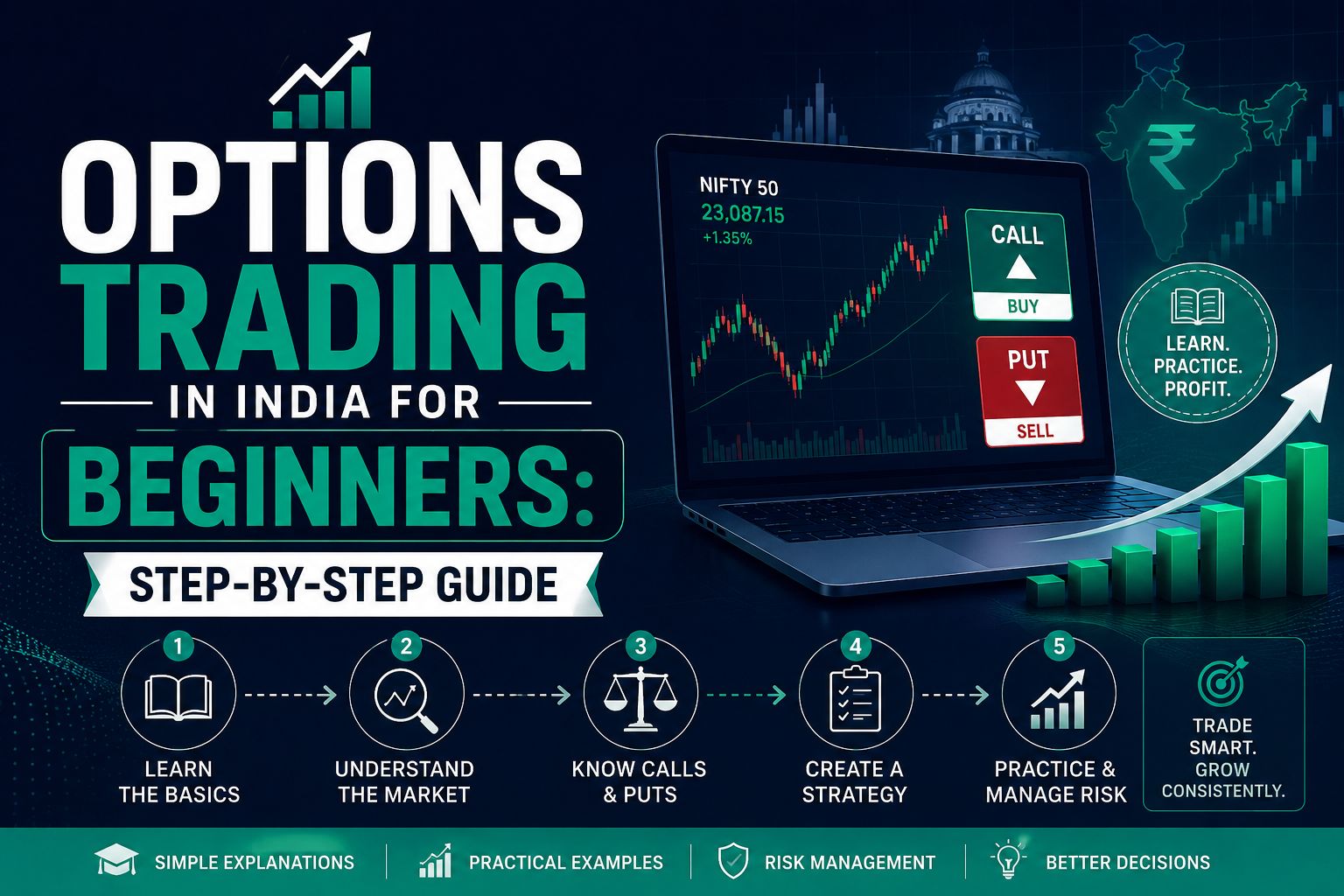
How can a beginner start options trading in India?
A beginner can start options trading in India by first learning the basics of calls, puts, strike price, expiry and lot size, then enabling F&O on their trading account, starting with simple strategies like buying a single call or put on Nifty or Bank Nifty with small position size, and following strict risk management using stop-losses and predefined capital allocation.
Table of Contents
- Chapter 1: What Is Options Trading in India?
- Chapter 2: Key Option Terms You Must Know (Indian Context)
- Chapter 3: Step-by-Step: How to Start Options Trading in India
- Chapter 4: Special Focus: Bank Nifty Options for Beginners
- Chapter 5: Common Beginner Mistakes to Avoid
- Chapter 6: Why Risk Management Matters More Now Than Ever
- Chapter 7: Where Algo Trading Comes In (And Why It Can Help Beginners)
- Chapter 8: What Is Algo Trading?
- Chapter 9: How Algo Trading Can Help a New Options Trader
- Chapter 10: Q7 Trading Solutions: Example of Ready-Made Algo Strategies
- Frequently Asked Questions (FAQs)
If you’re new to the stock market, options trading can look intimidating — all those CE, PE, strike prices, Greeks, weekly expiries, and people talking about Bank Nifty “lottery” trades. In reality, options are just risk tools packaged in a slightly technical way.
This guide will walk you through exactly how options trading works in India, how to get started step-by-step, and why you should treat it with respect (not as a get‑rich‑quick scheme). We’ll end with how algo trading and platforms like Q7 Trading Solutions can help new traders implement rules-based strategies instead of emotional decisions.
What Is Options Trading in India?
An option is a contract that gives you the right, but not the obligation, to buy or sell an underlying asset (like Nifty, Bank Nifty, or a stock) at a pre-agreed price (strike price) before a fixed expiry date.
In India, index and stock options are traded on exchanges like the NSE and BSE, settled in cash and regulated by SEBI. You don’t need to own the stock or the index to trade the option; you’re trading the right itself.
At a high level:
- A Call Option (CE) gives you the right to buy the underlying at the strike price if you want to.
- A Put Option (PE) gives you the right to sell the underlying at the strike price if you want to.
You pay a premium to buy this right; that premium is the maximum you can lose as an option buyer.
Because Indian options are European style, they are exercised only on expiry, but you can buy and sell your option in the market anytime before expiry at the current premium.
Key Option Terms You Must Know (Indian Context)
Before you place any trade, get these basics clear.
- Underlying
The asset on which the option is written — for example, Nifty 50, Bank Nifty, or Reliance. - Strike Price
The price at which you can buy (call) or sell (put) the underlying if you exercise the option. - Expiry Date
The last date on which the option is valid. In India, index options have weekly and monthly expiries, while stock options are typically monthly. - Lot Size
Options in India are traded in fixed lots, not single shares. SEBI has increased F&O lot size so that the contract value is around ₹15–20 lakh to discourage under‑capitalised retail traders from over-trading derivatives. - Option Premium
The price you pay (if you’re buying) or receive (if you’re selling) to enter the option contract. It depends on factors like underlying price, time to expiry, volatility, and moneyness. - Moneyness (ITM / ATM / OTM)
- In the Money (ITM): Option has intrinsic value.
- At the Money (ATM): Strike price is very close to the current market price.
- Out of the Money (OTM): Option has only time value and no intrinsic value.
- Beginners are usually advised to avoid far OTM “lottery” options and focus on ATM or slightly OTM contracts.
- Option Buyer vs Seller (Writer)
- Buyer: Limited risk (premium paid), potentially large reward, but low probability of success if used like a lottery.
- Seller/Writer: Higher probability of small profits, but very high risk; losses can be large if the market moves sharply.
- SEBI’s recent measures — higher margins, larger lot sizes, extra expiry‑day margins — are specifically aimed at reducing irresponsible naked option selling by small traders.
Step-by-Step: How to Start Options Trading in India
Let’s walk through a realistic, beginner-friendly path.
Step 1: Learn the Basics (Don’t Skip This)
Spend time understanding calls, puts, strike, expiry, premium, and basic strategies like long call, long put, and simple spreads.
Use this phase to understand how much you can lose in each type of strategy, not just how much you can make.
Step 2: Enable F&O Trading in Your Broker Account
To trade options on Nifty, Bank Nifty, or stocks, you need:
- A trading + demat account with F&O (derivatives) enabled.
- Income proofs (like ITR or salary slips) because brokers must verify that you’re eligible for derivatives trading under SEBI norms.
- To accept risk disclosures, where SEBI clearly highlights that a majority of retail investors lose money in F&O and that derivatives are high risk.
Make sure your broker offers:
- Real-time option chain
- Margin calculator
- Good charting
- Risk management tools (bracket orders, stop-loss, alerts)
Step 3: Choose Your Playground – Nifty, Bank Nifty, or Stocks
For most beginners, index options are often safer than single‑stock options because indices are diversified.
- Nifty 50 options: Comparatively smoother, lower intraday volatility than Bank Nifty.
- Bank Nifty options: Very popular but much more volatile, can move wildly around RBI news, macro events, and global cues.
- Stock options: Carry stock‑specific risk (results, news, corporate actions) and can be illiquid in many names.
Most brokers and educational content recommend that beginners start with index options (often Nifty) in small quantity, then move to Bank Nifty after understanding the speed and risk.
Step 4: Decide Your View – Up, Down, or Sideways
Options are powerful because they allow you to express a directional or non-directional view:
- Bullish (expect price to go up): Buy Call, Bull Call Spread, etc.
- Bearish (expect price to go down): Buy Put, Bear Put Spread, etc.
- Range-bound / low volatility: Option selling strategies or range strategies (but these are advanced and risky for beginners).
For absolute beginners, brokers and education portals generally suggest starting with simple buying strategies (long call or long put) because your risk is limited to the premium.
Step 5: Choose the Right Strike Price and Expiry
This is where most new traders go wrong — buying ultra-cheap far OTM options that expire at zero.
General beginner pointers from Indian brokers and platforms:
- Prefer ATM or slightly OTM strikes rather than far OTM “lottery” options.
- Use weekly expiry for short‑term intraday/1–2 day views; monthly expiry for slightly larger time frames.
- Remember: Time decay (Theta) works against option buyers; premium erodes as expiry approaches, especially if the market isn’t moving enough.
Step 6: Start With the Simplest Strategies
- a) Buying a Call (Bullish View)
If you expect Nifty to rise, you can buy a Nifty Call option at or near the current level.
- Max loss: Premium paid.
- Profit: Increases if Nifty moves strongly above your strike within the expiry
- b) Buying a Put (Bearish View)
If you expect Bank Nifty to fall, you can buy a Bank Nifty Put option.
- Max loss: Premium paid.
- Profit: Increases if Bank Nifty falls well below your strike before expiry.
Brokers like Angel One and Groww explicitly position “Buy Call if bullish, Buy Put if bearish” as the simplest starting point.
Step 7: Size Small, Use Stop-Loss, and Avoid Overtrading
Most credible guides repeat the same warning: derivatives are leveraged, and leverage is a double‑edged sword.
Some common risk-management suggestions from Indian brokers and educators:
- Start with 1 lot and treat it as tuition cost.
- Risk only a small percentage of your trading capital per trade.
- Always use stop-loss orders — especially in fast moves on Bank Nifty.
- Don’t trade because of tips/Telegram groups; build your own setups.
SEBI has tightened rules on margins, lot sizes, upfront premium collection, and expiry‑day margins precisely because a large number of retail traders have been taking oversized derivatives bets.
Special Focus: Bank Nifty Options for Beginners
Bank Nifty is where a lot of Indian intraday option traders spend their day — but it is not a toy.
Key points from large brokers on Bank Nifty options:
- Very high intraday volatility: Big moves during open (9:15–10:30 AM) and close (2:30–3:30 PM).
- Highly sensitive to RBI announcements, interest rate news, banking results and global risk sentiment.
- Requires a clear trading plan — predefined entry, stop-loss, and target.
- Beginners are advised to first paper trade or trade with very small size to understand its speed.
If you are brand new, it’s often wiser to learn on Nifty first, then step into Bank Nifty once you’re comfortable with how options premiums move.
Common Beginner Mistakes to Avoid
Based on broker education, SEBI commentary, and community observations, these are patterns to avoid:
- Treating weekly Bank Nifty options as a lottery ticket.
- Trading far OTM options just because the premium is cheap.
- Selling naked options (without hedges) with small capital — this can blow up accounts.
- Trading F&O purely based on someone else’s calls without understanding the risk.
- Ignoring news and events (RBI policy, major index rebalancing, global events).
- Not tracking total exposure — SEBI is actively considering linking F&O limits to income/net worth because many small investors are over-leveraging.
Why Risk Management Matters More Now Than Ever
SEBI and exchanges have been tightening F&O rules:
- Lot sizes increased to push contract value from ₹5 lakh to ₹15–20 lakh.
- Only one index per exchange can have weekly expiries, to reduce expiry‑day speculative frenzy.
- Upfront premium collection is mandatory — you must pay full premium when you buy options.
- Extra Extreme Loss Margin (ELM) on open short positions on expiry day.
SEBI is also evaluating linking F&O trading exposure to your declared income and net worth, so that brokers can limit how much risk each retail client takes.
For you as a beginner, the message is clear: treat options as a professional risk tool, not a casino chip.
Where Algo Trading Comes In (And Why It Can Help Beginners)
By now, you can see the pattern: most beginner problems in options are emotional, not technical — over‑trading, revenge trading, inconsistent position sizing, FOMO in Bank Nifty, not following stops, etc.
This is where algorithmic (algo) trading can genuinely help
What Is Algo Trading?
In simple terms, algo trading uses pre‑defined rules coded into a system to place trades automatically — entries, exits, position sizes and sometimes adjustments — based on logic instead of emotions.
Regulators in India have not banned algo trading; in fact, SEBI has created a formal framework so that even retail traders can use algorithms safely through brokers and approved platforms.
Key regulatory points:
- Every algo strategy used via a broker must be approved by the exchange.
- Strategies get a unique Algo ID, linked to every order the algo generates.
- Brokers must document the strategy, testing, risk controls, and get approval before going live.
- SEBI’s 2025–26 framework (effective April 1, 2026) is meant to encourage structured, well-controlled algo participation, not remove it.
So yes, properly implemented algo trading in India is legal, regulated, and supported by SEBI, NSE and BSE.
How Algo Trading Can Help a New Options Trader
For a beginner in Nifty/Bank Nifty options, a well‑designed algo can:
- Enforce discipline: It will not skip stop-loss or double your position out of anger.
- Execute faster: No hesitation in volatile markets; orders hit the system as soon as conditions are met.
- Apply consistent position sizing: Same risk per trade, every time.
- Backtest rules: You can see how a strategy would have behaved historically before going live (via platforms that support backtesting).
Of course, algos are not magic — they can lose money too. The edge comes from a well‑researched strategy + strict risk controls + consistent execution, not from automation alone.
Q7 Trading Solutions: Example of Ready-Made Algo Strategies
Many new traders don’t have the coding skills or time to build and test their own strategies from scratch. That’s where third‑party algo providers come in.
Platforms like Q7 Trading Solutions position themselves as providers of ready-made, rules-based algorithmic trading strategies for Indian markets, so traders can subscribe to or deploy pre‑tested strategies instead of building everything themselves.
Your article should not make performance guarantees, but you can honestly say:
- Q7 focuses on algorithmic trading strategies, comparisons and performance dashboards for different approaches.
- Such platforms sit on top of broker APIs (subject to SEBI and exchange approval), letting you run rule‑driven strategies on Nifty/Bank Nifty and other instruments without manual clicking for every trade, as long as you follow all regulatory guidelines.
For a beginner, the value is in being able to start their options journey with structured, backtested, rule-based strategies rather than random trades — while still taking the time to understand what the strategy does and what risks it carries.
FAQs
Options are powerful but high‑risk instruments. Beginners can start with simple, limited‑risk strategies like buying a single call or put in small size, but only after understanding basics like strike, expiry, and premium, and with strong risk management.
There is no fixed SEBI‑mandated minimum, but F&O lot sizes and premiums mean you should have enough capital to keep your per‑trade risk small (for example, only a small percentage of your total capital per trade). SEBI has increased contract sizes precisely to discourage under‑capitalised traders from heavy F&O speculation.
Bank Nifty options are extremely liquid but also very volatile. Brokers generally suggest that beginners start with paper trading or very small position sizes, and first understand how quickly premiums move before scaling up.
No options strategy is truly “safe”, but many beginner guides recommend buying (not selling) options like a single call or put, or limited‑risk vertical spreads, because the maximum loss is limited to the premium.
If you use an approved algo through a broker/platform, the algo itself must be approved by the exchange, and your broker must comply with SEBI’s 2025–26 framework for algorithmic trading. You must still provide required consents and use only exchange‑approved algorithms.
No. SEBI has not banned algo trading. In fact, it has built a legal framework that formalises retail algo participation under exchange and broker supervision, effective from April 1, 2026.
A beginner can use third‑party algo platforms that work with their broker’s API, provided the strategies are approved and compliant. Platforms like Q7 Trading Solutions offer rule‑based strategies that can help enforce discipline, but traders still need to understand the strategy logic and the risks involved.