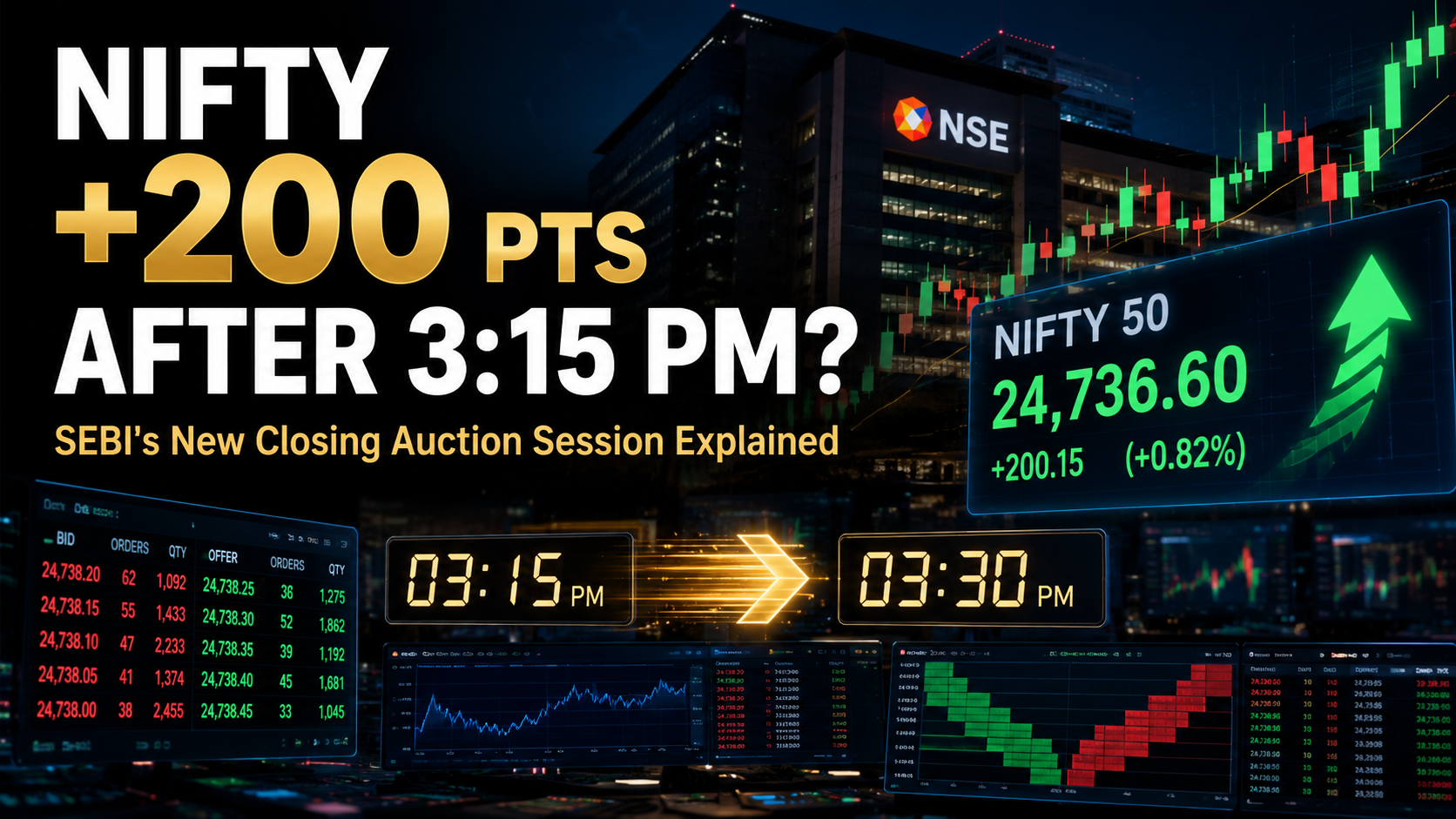
Why did Nifty jump nearly 200 points after 3:15 PM?
Nifty’s official closing price increased because of SEBI’s new Closing Auction Session (CAS). Instead of using the last traded price at 3:15 PM, the exchange now determines the closing price through an auction process for eligible F&O stocks, which can result in a different official closing value.
Table of Contents
- Chapter 1: Why Did Nifty Jump After 3:15 PM?
- Chapter 2: What Is the Closing Auction Session (CAS)?
- Chapter 3: Why Did the Official Closing Price Increase?
- Chapter 4: How Does the Closing Auction Session Work?
- Chapter 5: What Should Traders Expect?
- Chapter 6: How Should Retail Traders Respond?
- Chapter 7: Key Takeaways for Traders)
- Chapter 8: Frequently Asked Questions
The official Nifty closing price surprised thousands of traders after showing a nearly 200-point jump beyond the regular market close. Here’s why it happened and what the new SEBI Closing Auction Session means for investors and traders.
Why Did Nifty Jump After 3:15 PM?
Thousands of traders were surprised when Nifty closed nearly 200 points higher than its 3:15 PM level. At the end of regular trading, Nifty was trading around 24,573, but the official closing value was recorded at 24,774.30. This unusual difference led many market participants to wonder whether there had been sudden institutional buying or a technical issue. In reality, neither was the case. The sharp difference was the result of SEBI’s newly introduced Closing Auction Session (CAS), which changed the way official closing prices are determined for eligible stocks
What Is the Closing Auction Session (CAS)?
From 3 August 2026, SEBI introduced the Closing Auction Session for Futures & Options (F&O) stocks. Under this mechanism, the official closing price is no longer based solely on the last traded price at 3:15 PM. Instead, the exchange conducts a structured auction after regular trading hours, where buy and sell orders are matched to discover a fair closing price. This closing price is then used for index calculation, settlement, and several market-related processes.
Why Did the Official Closing Price Increase?
During the first Closing Auction Session, several heavyweight index stocks, including HDFC Bank, ICICI Bank, Reliance Industries, Infosys, Bharti Airtel, Bajaj Finance, TCS, and Axis Bank, discovered higher closing prices during the auction. Since these companies carry significant weight in the Nifty 50 index, their higher auction prices lifted the official Nifty closing value, even though normal trading had already ended.
How Does the Closing Auction Session Work?
The Closing Auction Session follows a structured timeline after regular market hours. Between 3:15 PM and 3:20 PM, the exchange enters the transition phase and calculates the reference price. From 3:20 PM to 3:25 PM, traders can place both market and limit orders. Between 3:25 PM and 3:30 PM, only limit orders are accepted. Finally, the auction closes randomly between 3:28 PM and 3:30 PM, after which matching takes place to determine the official closing price.
What Should Traders Expect?
The introduction of CAS may lead to higher volatility during the initial implementation period as traders and institutions adapt to the new system. Investors may also notice temporary differences between spot and futures prices around the market close. Mutual fund Net Asset Value (NAV) calculations could also reflect slight variations because they rely on official closing prices. Institutional participation is expected to have a greater influence during the auction until market liquidity becomes more balanced.
How Should Retail Traders Respond?
Retail traders should understand that differences between the 3:15 PM trading price and the official closing price are now a normal part of the market structure. Instead of reacting emotionally to these price movements, traders should continue following disciplined trading strategies, maintain appropriate stop-loss levels, and use proper hedging techniques, especially during expiry sessions. As with any regulatory change, markets typically become more efficient as participation and liquidity improve over time.
Key Takeaways for Traders
The recent 200-point difference in Nifty’s closing value was neither market manipulation nor a technical glitch. It was the result of SEBI’s new Closing Auction Session, designed to improve price discovery and create a more efficient closing mechanism. While the transition may initially confuse traders, understanding how the system works can help investors make informed decisions and avoid unnecessary panic. Successful traders adapt to market changes, and staying informed is one of the most important steps toward long-term success.
Frequently Asked Questions
The Closing Auction Session is a mechanism introduced by SEBI to determine the official closing price of eligible F&O stocks through an auction process after regular market hours.
The official closing price was determined using the Closing Auction Session, where auction-based price discovery resulted in higher closing prices for several heavyweight stocks.
Yes. The new mechanism can temporarily create differences between spot and futures prices around the market close and may influence settlement-related calculations.
No. The Closing Auction Session is a regulatory change introduced by SEBI to improve price discovery and establish a more transparent official closing price.
Retail traders should avoid panic, understand the new closing mechanism, continue using disciplined trading strategies, and focus on long-term consistency rather than short-term closing price differences.