What is the India-US tech trade deal?
It is a strategic framework aiming for $500 billion in reciprocal trade over five years, focusing on semiconductor manufacturing, AI infrastructure, GPUs, and reducing supply chain barriers.
Which sectors will benefit most?
The semiconductor, electronics manufacturing, data center, and automotive component industries are expected to see the most significant growth due to lower tariffs and joint investment programs.
Table of Contents
- Chapter 1: What Are Intraday Algo Strategies?
- Chapter 2: Understanding Positional Algo Strategies
- Chapter 3: Lifestyle Fit: Busy Bee or Screen Addict?
- Chapter 4: Pros, Cons, and Real-World Risks
- Chapter 5: Implementing Algos: Tools and Tips for Indians
- Chapter 6: Future of Algo Trading in India
- Chapter 7: Frequently Asked Questions (FAQ)
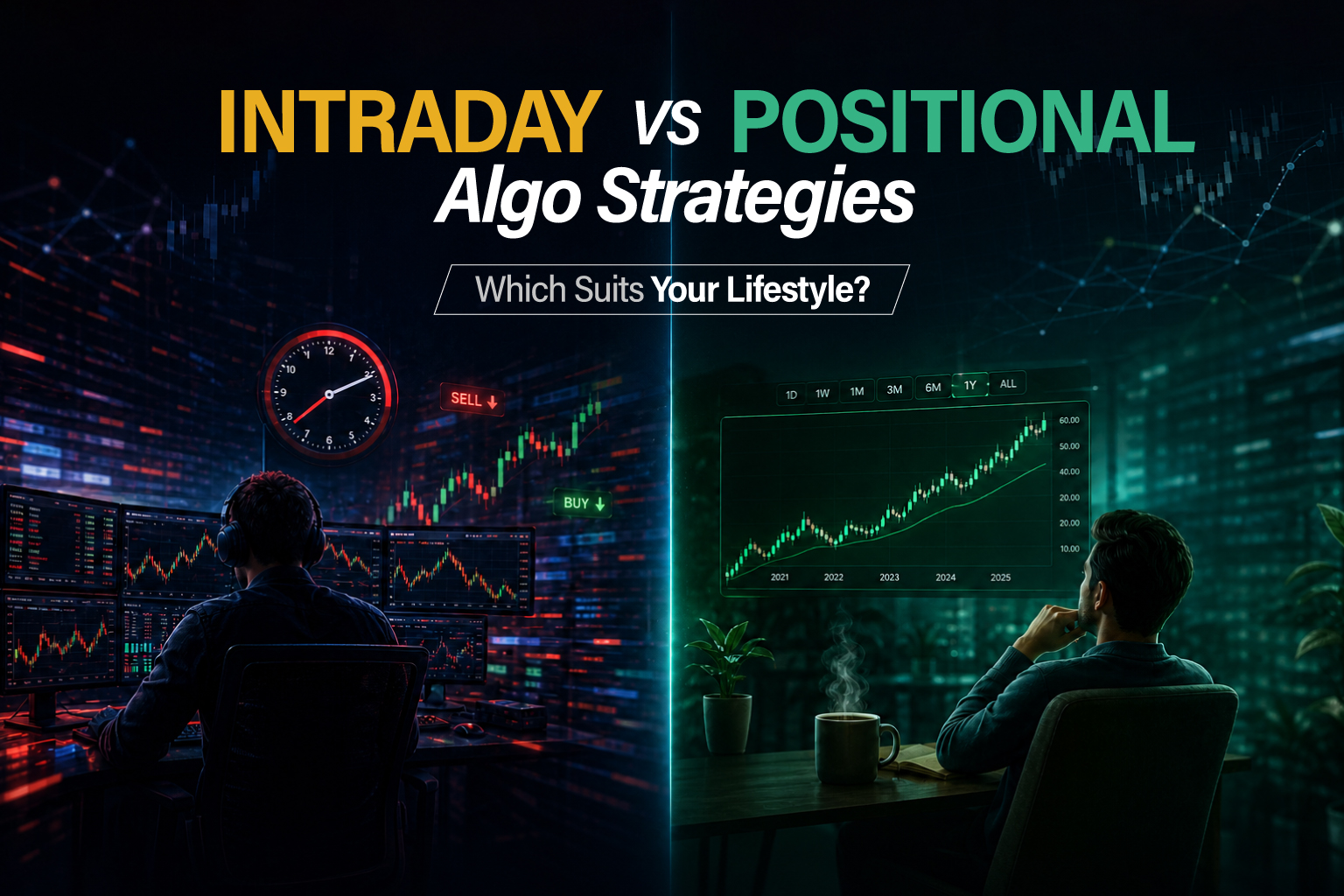
Hey there, trader! Ever stared at your trading screen wondering if you’re cut out for the adrenaline rush of intraday action or the chill vibe of positional plays? You’re not alone. With algo trading exploding in popularity—especially in India where platforms like Zerodha and Upstox make it accessible—picking the right strategy isn’t just about profits. It’s about fitting trading into your life. Intraday algos zip through same-day trades, while positional ones hold for days or weeks. Let’s break it down section by section so you can decide what matches your daily grind, risk appetite, and screen time.
What Are Intraday Algo Strategies?
Picture this: Markets open at 9:15 AM, and your algo kicks into high gear. Intraday strategies buy and sell within the same day, squaring off before 3:30 PM. No overnight worries about global news gaps. Algos here shine in scalping, momentum bursts, or mean reversion—like VWAP strategies that exploit price deviations from the volume-weighted average price.
These are perfect for spotting micro-trends using indicators like RSI, moving averages, or opening range breakouts. In India, with Nifty’s volatility, a simple EMA crossover algo can snag quick 0.5-1% moves multiple times a day. But here’s the catch: You need constant monitoring or a rock-solid VPS setup, as slippage from latency kills edges. Full-timers with 6-8 hours daily love this—think Mumbai pros glued to five screens.
Pros? High trade frequency builds stats fast for backtesting. Cons? Emotional whipsaws and brokerage eats profits (STT is brutal at 0.025% on sell side). Studies show intraday volatility hits ~0.57% daily vs positional’s smoother 0.558%.
Understanding Positional Algo Strategies
| Aspect | Intraday Algo | Positional Algo |
|---|---|---|
| Timeframe | Same day (9:15 AM – 3:30 PM) | Days to weeks |
| Capital Needed | Low (leverage heavy) | Higher (holds positions) |
| Risk Level | High (volatility spikes) | Medium (trend buffer) |
| Monitoring | 100% screen time or auto | Weekly checks |
| Costs | High brokerage/STT | Lower per trade |
| Suitability | Full-time hustlers | 9–5 jobbers |
Lifestyle Fit: Busy Bee or Screen Addict?
Your lifestyle is the boss. Got a 9-5 in Lucknow traffic? Positional algos let you set-it-and-forget-it—check evenings via apps. One Reddit algo trader nailed it: “Positional for dads; intraday for insomniacs.”
Full-time? Intraday’s dopamine hits suit night owls riding US cues. Women balancing home? Positional’s flexibility wins, per Groww insights. Risk tolerance matters too—intraday’s stress ages you faster.
Real talk: Hybrid algos (intraday entries, positional holds) blend both, but start simple.
Pros, Cons, and Real-World Risks
Intraday Pros: Quick capital turnover, no gap risk, leverages volatility.
Cons: Exhausting, high failure rate (90% lose), margin calls.
Positional Pros: Less time, bigger wins, sleep easy.
Cons: Opportunity cost, drawdowns in ranges.
SEBI data: 89% intraday traders lose; positional far better for retail. Always backtest on AlgoTest—Indian data rules.
Implementing Algos: Tools and Tips for Indians
Start with Streak or AlgoTest for no-code. Code in Python? Pine Script on TradingView. Brokers: Zerodha Kite API. VPS mandatory for intraday. Risk 1% per trade, position size via Kelly.
Example: Intraday—Short straddle at 9:20 AM. Positional—MA cross + ADX filter.
Which One for You? Quick Quiz
Screen time? >4hrs = Intraday.
Risk lover? Yes = Intraday.
Full-time? Positional otherwise.
Test on paper!
Future of Algo Trading in India
The future of algorithmic trading in India is no longer a distant vision; it is the current reality. As retail participation grows and technological infrastructure becomes more accessible, we are witnessing a shift where systematic, data-driven decisions are replacing manual guesswork at a record pace. With algo participation on segments like stock futures reaching as high as 73% in FY26, the reliance on speed, precision, and backtested logic is becoming the new industry standard.
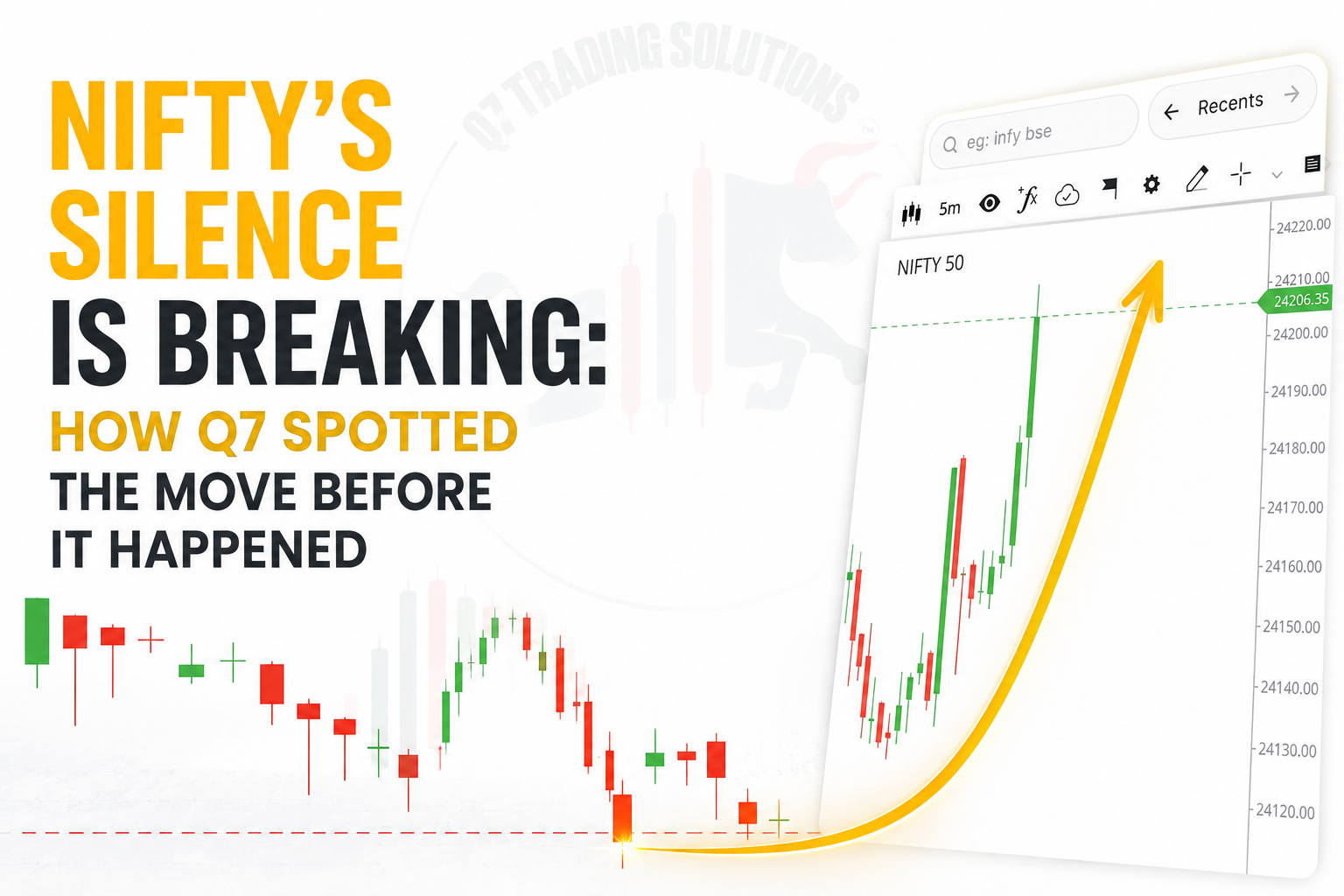
At Q7 Trading Solutions , we are actively shaping this future by bridging the gap between complex quantitative research and retail accessibility. We believe the future belongs to traders who can leverage AI to analyze vast historical datasets in real-time, removing the emotional friction that traditionally hampers individual success. By providing AI-powered, prebuilt strategies, we enable our community to focus on their life while our system works to optimize their investments with transparency and consistency.
Our alignment with this future is rooted in the “no-code” revolution. We understand that many traders have the ambition but lack the deep technical expertise to code complex algorithms. By offering an environment where users can simply link their trading accounts via API to our proven, SEBI-compliant systems, we are democratizing access to institutional-grade tools. Whether you are a beginner or a professional, our platform provides the stability and performance needed to thrive in India’s fast-paced market.
As India continues its integration with global financial systems, the complexity of trading will only increase. The future will favor platforms that prioritize rigorous backtesting, robust risk management, and the ability to adapt to changing volatility. At Q7 Trading Solutions, we remain committed to this evolution, continuously refining our AI-driven models to ensure our community stays ahead of the curve, trading smarter and with greater confidence.
Frequently Asked Questions (FAQ)
Intraday algos close all positions by market end (same day), focusing on short-term price swings. Positional algos hold for days or weeks, capturing larger trends. This key distinction affects monitoring needs and risk exposure.
Positional trading fits best for 9-5 professionals. It requires minimal daily oversight—just periodic checks—unlike intraday’s constant attention. Many Indian retail traders with jobs swear by it for work-life balance.
Yes, intraday involves higher volatility and emotional stress from rapid trades. Positional spreads risk over time with trend filters. SEBI stats highlight 89% intraday loss rates vs. better positional outcomes.
Platforms like AlgoTest, Tradetron, and Streak offer no-code options. Zerodha’s Kite API suits coders. Use VPS for intraday reliability and backtest rigorously before live deployment.
Absolutely—it’s more forgiving with lower time demands. Start with simple trend-following algos on Nifty or Bank Nifty. Build experience gradually to avoid common pitfalls like over-leveraging.
Intraday suffers more from frequent trades (higher STT at 0.025% sell-side). Positional minimizes costs with fewer entries/exits. Factor this into backtests for realistic profit projections.
Essential! Test on historical Indian data (e.g., AlgoTest) to validate win rates, drawdowns, and lifestyle fit. Poor backtests predict live failures—don’t skip this step.