Why did Nifty suddenly move higher during the August 2026 expiry?
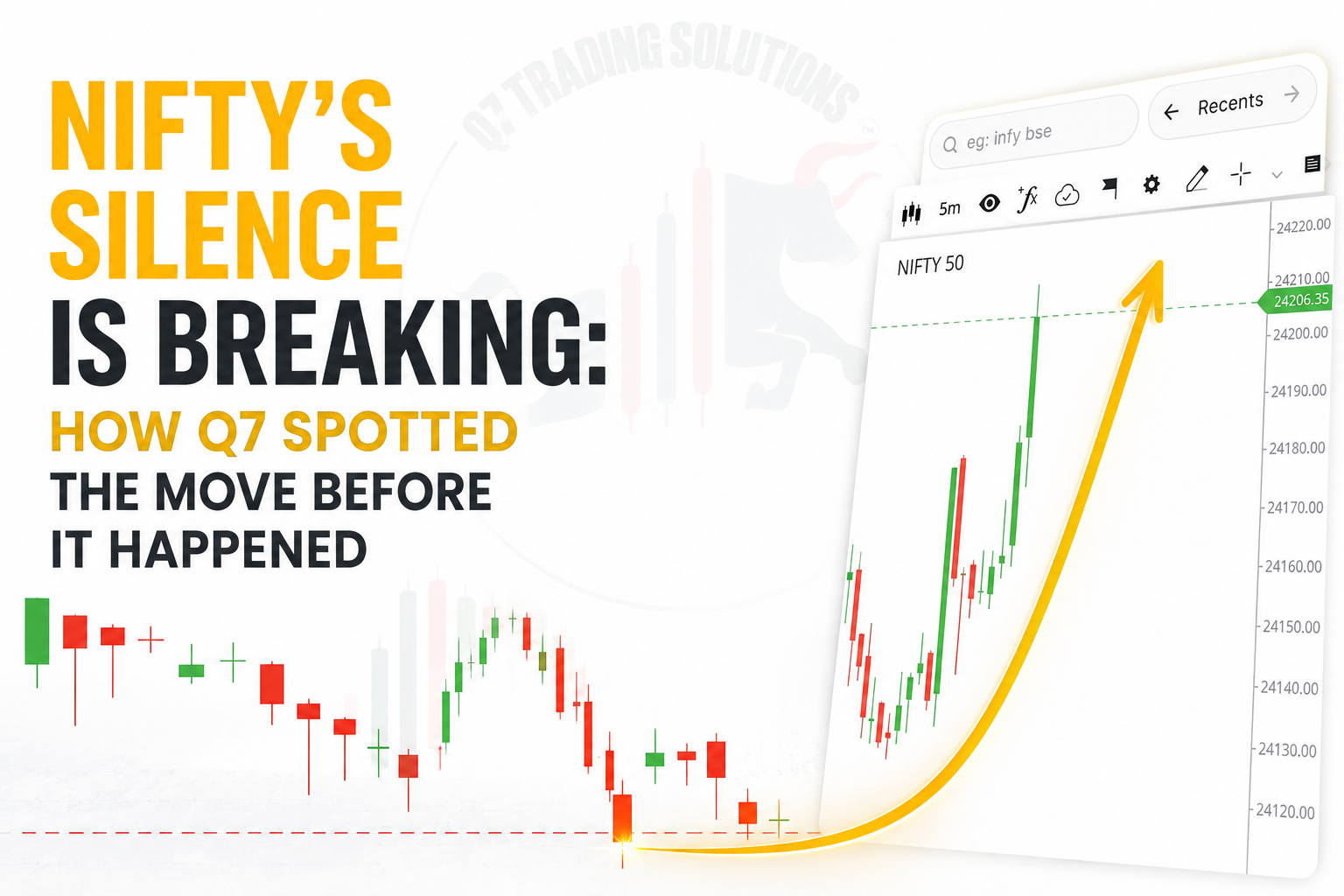
Nifty moved sharply higher during the August 2026 expiry as short-covering, expiry-related positioning and improving market momentum contributed to strong buying. The index recovered from an intraday low near 24,115 and closed at 24,334.55, highlighting how quickly momentum can change after a prolonged period of consolidation.
Table of Contents
- Chapter 1: The Market Was Quiet. Then Nifty Moved: What Q7’s Algorithm Saw
- Chapter 2: A Market That Refused to Move
- Chapter 3: A Major Structural Change Entered the Market
- Chapter 4: The Positioning Behind the Market
- Chapter 5: The Silence Was Not the Absence of Opportunity
- Chapter 6: From Market Silence to Sudden Momentum
- Chapter 7: Why Low Volatility Can Create a False Sense of Comfort
- Chapter 8: The Real Opportunity May Be in the Transition
- Frequently Asked Questions
The Market Was Quiet. Then Nifty Moved: What Q7’s Algorithm Saw
For months, the Indian equity market has tested the patience of traders and investors. The Nifty has spent an unusually long period moving within a relatively narrow range, creating a market environment where directional opportunities have been difficult to capture consistently. What made this phase even more unusual was the amount of time the index spent around similar levels.
On June 28, 2024, the Nifty 50 closed at 24,010.60. On August 25, 2026, it closed at 24,334.55. Despite more than two years passing between these two reference points, the headline index remained remarkably close to the same zone. That makes the current phase less about a normal period of consolidation and more about understanding what could potentially be building underneath the surface.
The question is no longer simply why the market has remained quiet. The bigger question is what happens when that silence finally breaks.
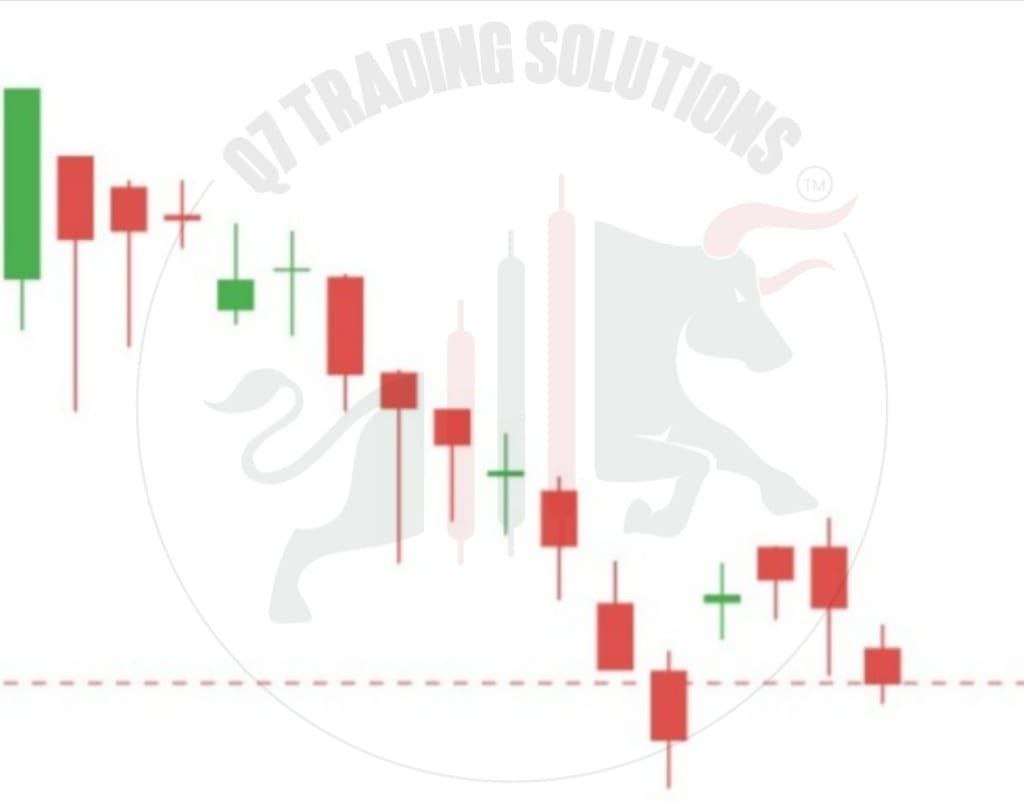
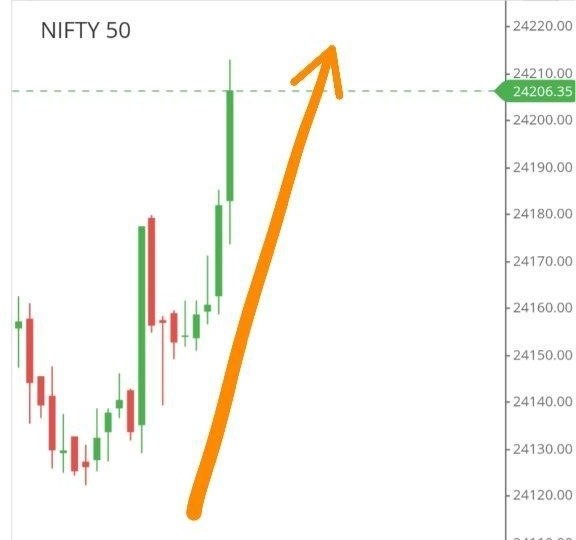
A premium Nifty chart showing the long period of consolidation, with a subtle upward trajectory beginning toward August 2026.
A Market That Refused to Move
A market does not need to crash to become difficult. Sometimes, the most challenging environment is one where prices simply refuse to establish a sustained direction.
During prolonged sideways phases, traders can become accustomed to small price movements and compressed volatility. Strategies that work well in stable conditions may appear increasingly comfortable, while directional traders can find themselves repeatedly entering and exiting without meaningful follow-through.
This environment can also influence market psychology. When a market remains quiet for long enough, participants can begin assuming that the current range will continue indefinitely. But markets do not remain compressed forever. Eventually, positioning, liquidity, sentiment and price action can combine to create a much larger move.
That is why periods of extreme calm deserve attention rather than indifference.
A Major Structural Change Entered the Market
The market environment also changed structurally in August 2026 with the introduction of the Closing Auction Session, commonly known as CAS.
From August 3, 2026, eligible F&O stocks moved into a closing auction mechanism after continuous trading ends at 3:15 PM. The closing auction runs through a separate process designed to determine the closing price through an auction mechanism.
This created a new dimension around the final portion of the trading day. Traders now had to consider not only the continuous market but also how positioning and orders could interact with the closing auction process.
visual: A clean timeline showing 3:15 PM → Closing Auction Session → 3:35 PM.
The introduction of CAS became particularly interesting around the August derivatives expiry because expiry sessions already tend to involve significant repositioning, hedging and adjustment of derivative positions.
The Positioning Behind the Market
Another important factor was the positioning of foreign institutional investors.
At the beginning of the August series, market reports highlighted an extremely defensive FII futures positioning, with the FII long-short ratio reported at only 9.59%. Such positioning indicated that foreign institutional participants were heavily skewed toward short positions rather than long positions.
That does not mean a rally automatically has to follow. However, heavily one-sided positioning can become important when the market begins moving in the opposite direction.
When short positions start coming under pressure, traders may begin reducing those positions. That requires buying back futures or other positions that were previously sold. If a large number of participants start doing this at the same time, the resulting buying pressure can accelerate an upward move.
This is the basic mechanism behind short covering.
The market does not necessarily need a massive amount of fresh money to create a sharp move. Sometimes, the unwinding of existing positions can provide enough buying pressure to push prices significantly higher.
The August Expiry Reversal
The August expiry session provided an important example of how quickly the market can change character.
On August 25, 2026, the Nifty traded down to approximately 24,115 during the session before recovering sharply and closing at 24,334.55. The move from the intraday low to the closing level was significant because it demonstrated that the market could transition from weakness to strong buying within the same session.
The important point is not simply that Nifty closed higher. The larger takeaway is how quickly the market changed direction after spending weeks in a relatively muted environment.
A market that has been quiet for a prolonged period can sometimes produce a very different type of move once positioning begins to unwind.
The Silence Was Not the Absence of Opportunity
This is where the Q7 approach becomes relevant.
While the broader market was dealing with low directional movement, Q7’s algorithm continued to monitor market conditions and identify opportunities according to its trading methodology.
For an algorithmic system, a sideways market is not necessarily an environment where nothing can happen. It is an environment where signals, positioning and market behaviour need to be evaluated systematically.
The objective is not to predict every single market move. The objective is to identify conditions where the probability and structure of a trade fit the strategy’s predefined framework.
This is also why systematic trading can become particularly interesting during difficult market phases. Human traders can become impatient when the market does not move. Algorithms, on the other hand, can continue evaluating predefined conditions without the emotional pressure associated with waiting.
From Market Silence to Sudden Momentum
The August expiry session highlighted a sequence that traders should pay attention to.
First came an extended period of muted movement. Then came a new market structure through CAS. At the same time, derivatives positioning remained heavily skewed. Volatility remained subdued, and the market continued to trade within a relatively compressed range.
Then the market began moving.
When these factors start interacting, the market can transition from a low-volatility environment into a high-momentum environment surprisingly quickly.
This is why looking at only one indicator can be misleading. Price action, derivatives positioning, open interest, volatility, volume and institutional activity need to be considered together when assessing whether the market environment is changing.
Why Low Volatility Can Create a False Sense of Comfort
Low volatility often creates a feeling of stability. When the market moves within a narrow range for an extended period, option premiums can remain relatively compressed and option-selling strategies can appear attractive. Traders may become comfortable collecting small premiums repeatedly because the underlying index is not making large directional moves.
The problem is that a low-volatility environment can change very quickly. When realized volatility suddenly expands, strategies that were comfortable during a range-bound market can face a completely different risk profile. A position that looked relatively safe while the market was quiet can become vulnerable when the underlying starts making large directional moves. That is why experienced traders do not look at low volatility simply as an opportunity. They also ask what could happen if volatility expands.
The Bigger Nifty Picture
The most interesting part of the current market is the amount of time the Nifty has spent around similar levels. In June 2024, Nifty closed around 24,010. By August 2026, it was still trading around the 24,000–24,300 region. This does not mean that the market has produced no returns for investors during this period, because individual stocks, sectors and dividends can tell very different stories.
But from the perspective of the headline Nifty level, the prolonged consolidation is difficult to ignore. Long periods of consolidation can eventually become important because they create a large amount of positioning around a relatively narrow price range. When price finally moves decisively away from that range, participants who positioned for the old environment may be forced to adjust. That adjustment can create additional momentum.
What the August Move Could Mean
The August expiry move does not prove that a massive bull market has already begun. That distinction is important. One strong session cannot guarantee what the Nifty will do over the next few weeks. Markets can produce sharp rallies and then return to their previous trading ranges. However, the move does provide a reason to reassess the market environment.
The combination of prolonged consolidation, defensive institutional positioning, structural changes to the closing mechanism and a sharp expiry-session recovery makes the next phase particularly interesting to watch. The market now needs to confirm whether the August move was simply an expiry-related event or the beginning of a broader change in momentum.
September Expiry Could Be the Next Major Test
The September 2026 derivatives expiry is scheduled for September 29. That makes the next expiry an important checkpoint for traders watching whether the August recovery develops into sustained momentum. If the Nifty continues to hold higher levels, participation expands and short positions continue to unwind, the market could enter a very different environment from the prolonged consolidation seen previously.
On the other hand, if the index quickly returns to its previous range, the August move may prove to have been more temporary. The market will ultimately provide the confirmation.
The Real Opportunity May Be in the Transition
The most interesting market phases are often not the periods when everyone already agrees on the direction. They are the transition periods. When volatility is compressed, positioning is crowded and price remains trapped in a narrow range, the eventual change in market behaviour can catch participants off guard. That is why preparation matters.
By the time a move becomes obvious to everyone, a significant portion of the move may already have happened. The August expiry session demonstrated how quickly Nifty could move from an intraday low near 24,115 to a close above 24,300. The lesson is not that every trader should immediately take a bullish position. The lesson is that a quiet market should never automatically be treated as a market without opportunity.
What Traders Should Watch Next
The next phase of the market should be evaluated through price, positioning and volatility. If price continues to hold above important levels while short positions are unwound and volatility expands alongside directional movement, it could indicate that the market environment is changing. If those signals fail to develop, the Nifty may simply return to the range that has dominated the market for an extended period. This is why Q7’s approach remains focused on systematic market analysis rather than emotional predictions. The objective is to be prepared for the move when the market provides confirmation.
The Q7 Perspective
The August expiry was more than just another green session. It was a reminder of how quickly market conditions can change after an extended period of silence. For months, traders had been dealing with a market that offered limited directional movement. Then, around expiry, the Nifty demonstrated that the underlying market structure could still produce a sharp reversal within a single session.
Q7’s algorithm was designed to operate within such changing conditions by continuously evaluating market signals and acting according to its defined strategy framework. The next major question is whether the August move develops into something larger. The answer will not come from predictions alone. It will come from price action, positioning, volatility and confirmation from the market itself.
The Market May Have Started Talking Again
A prolonged period of silence can make traders believe that nothing significant is happening. But markets often build their next move while they appear uneventful. The August expiry has provided the first important sign that the extremely compressed environment may be changing. Whether this becomes the beginning of a larger directional phase remains to be seen. But one thing is certain: after months of waiting, the market is once again giving traders something worth watching.
The silence may be breaking.
And the next few weeks could be important.If you want to understand how Q7’s algorithmic strategies approach changing market conditions and how the system works, connect with the Q7 team. @Q7sales_support
Disclaimer
This article is intended for educational and informational purposes only and should not be considered investment advice, a recommendation to buy or sell securities, or a guarantee of future returns. Trading and investing involve substantial market risk. Past performance does not guarantee future results. Readers should evaluate their own financial situation and risk tolerance and consult an appropriately qualified professional before making investment decisions.
Frequently Asked Questions
CAS is a dedicated closing auction mechanism introduced for eligible F&O stocks from August 3, 2026. It determines the closing price through an auction process after continuous trading ends.
When traders holding short positions buy back those positions to reduce exposure, their buying can add upward pressure to the market. If many short positions are unwound simultaneously, the resulting demand can accelerate a move.
Yes. On August 25, 2026, Nifty closed at 24,334.55, up 0.48%, after falling to an intraday low around 24,115.
No. One strong session cannot guarantee a future trend. Traders should look for confirmation through price action, positioning, volume and volatility.
Q7’s algorithmic strategies are designed to systematically identify and act on market conditions according to their respective trading methodologies. Algorithmic trading does not eliminate market risk.
The September 2026 derivatives series is scheduled to expire on September 29, 2026.