What did RBI announce in the August 2026 Monetary Policy?
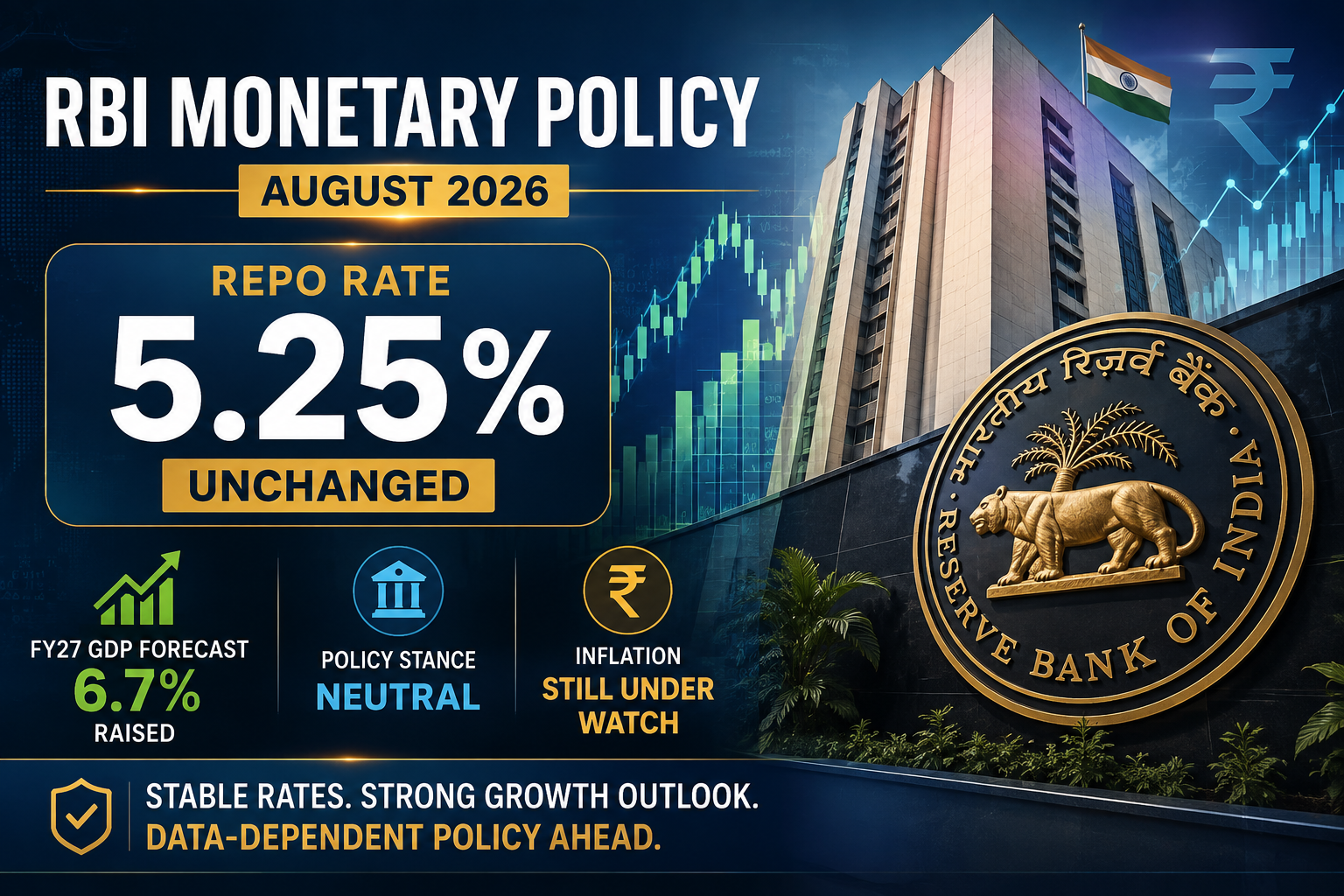
The RBI kept the repo rate unchanged at 5.25%, maintained its Neutral policy stance, and raised India’s FY27 GDP growth forecast to 6.7%. While inflation remains elevated due to food and fuel prices, the central bank expects it to moderate after the third quarter of FY27.
Table of Contents
- Chapter 1: RBI Keeps Repo Rate Unchanged
- Chapter 2: Key Highlights of the August 2026 MPC Meeting
- Chapter 3: Growth Outlook Improves
- Chapter 4: Inflation Remains the Primary Concern
- Chapter 5: Global Risks Continue to Influence Policy
- Chapter 6: Market Reaction to RBI's Decision
- Chapter 7: What Does This Mean for Investors?
- Chapter 8: Frequently Asked Questions
The Reserve Bank of India maintained the repo rate at 5.25% while upgrading India’s FY27 GDP growth forecast to 6.7%. Here’s everything investors, traders, and businesses need to know about the latest Monetary Policy Committee (MPC) meeting.
RBI Keeps Repo Rate Unchanged
The Reserve Bank of India (RBI) has decided to keep the repo rate unchanged at 5.25%, maintaining its Neutral policy stance in the August 2026 Monetary Policy Committee (MPC) meeting. The decision reflects the central bank’s balanced approach toward supporting economic growth while ensuring inflation remains under control. Along with the repo rate, the Marginal Standing Facility (MSF) and Bank Rate remain at 5.50%, while the Standing Deposit Facility (SDF) continues at 5.00%.
Key Highlights of the August 2026 MPC Meeting
The latest monetary policy delivered several important announcements. While interest rates remained unchanged, the RBI revised its FY27 real GDP growth forecast upward to 6.7%, indicating confidence in India’s economic resilience. The central bank acknowledged that domestic demand, investment activity, and the services sector continue to support economic expansion. At the same time, it emphasized that future policy decisions will remain data-dependent as inflation risks continue to evolve.
Growth Outlook Improves
India’s economic outlook remains encouraging despite global uncertainty. Strong domestic consumption, sustained investment activity, and resilient service exports continue to drive growth across multiple sectors. The RBI’s decision to upgrade its GDP forecast signals confidence in the country’s medium-term economic prospects. However, the central bank also noted that manufacturing businesses continue to face cost pressures, while monsoon conditions could influence agricultural production and rural demand.
Inflation Remains the Primary Concern
Although India’s growth outlook has improved, inflation continues to remain the RBI’s biggest focus. Food and fuel prices are still the primary contributors to elevated inflation, even though price pressures are not yet broad-based across the economy. The RBI expects inflation to peak during the third quarter of FY27 before gradually moderating. Core inflation is also expected to stabilize toward the end of the financial year, provided supply-side conditions improve.
Global Risks Continue to Influence Policy
The global economic environment remains uncertain. Ongoing geopolitical tensions in West Asia, trade tariff concerns, and slowing global growth continue to create volatility across international financial markets. Several major central banks are also maintaining restrictive monetary policies, making global capital flows more unpredictable. These external risks remain important factors influencing the RBI’s cautious policy stance.
Market Reaction to RBI’s Decision
Financial markets responded cautiously to the policy announcement. The benchmark 10-year Government Security (G-Sec) yield eased to around 6.7835%, reflecting stable expectations for interest rates. Meanwhile, the Indian Rupee weakened beyond ₹95 per US Dollar, highlighting continued pressure from global market conditions and currency movements. Overall, market participants viewed the policy as broadly neutral to positive.
What Does This Mean for Investors?
The RBI’s decision provides stability for financial markets while reinforcing confidence in India’s growth story. Stable interest rates support borrowing, investment, and business expansion, while the improved GDP outlook reflects continued economic resilience. However, investors should continue monitoring inflation trends, future MPC guidance, food and fuel prices, bond yields, and currency movements. As the RBI has reiterated, future monetary policy decisions will remain firmly data-dependent.
The August 2026 Monetary Policy reflects a balanced approach by the Reserve Bank of India. By keeping the repo rate unchanged while raising the GDP growth forecast, the RBI has demonstrated confidence in India’s economic momentum without losing focus on inflation management. While global uncertainties and food inflation remain key challenges, the policy provides stability for investors and businesses. Going forward, inflation data and economic indicators will continue to play a crucial role in shaping future interest rate decisions.
Frequently Asked Questions
The Reserve Bank of India (RBI) kept the repo rate unchanged at 5.25% and maintained its Neutral policy stance. It also revised India’s FY27 real GDP growth forecast upward to 6.7% while stating that future policy decisions will remain data-dependent.
The RBI decided to keep interest rates unchanged to maintain a balance between supporting economic growth and controlling inflation. Although India’s growth outlook has improved, inflation—particularly from food and fuel prices—continues to require close monitoring.
As of the August 2026 Monetary Policy Committee (MPC) meeting, the RBI repo rate stands at 5.25%
The RBI identified several key risks, including elevated food and fuel inflation, manufacturing cost pressures, geopolitical tensions, global economic uncertainty, trade tariff risks, and monsoon-related uncertainties that could affect inflation and growth.
Following the policy announcement, the 10-year Government Security (G-Sec) yield eased to around 6.7835%, while the Indian Rupee weakened beyond ₹95 per US Dollar. Overall, the market viewed the policy as neutral to positive because rates remained stable and the GDP outlook improved.
Investors should closely watch inflation trends, food and fuel prices, future MPC guidance, GDP growth momentum, bond yields, and the movement of the Indian Rupee. These factors will influence future RBI policy decisions and overall market sentiment.
An unchanged repo rate generally provides stability. Borrowers may continue to benefit from relatively stable lending rates, while investors gain confidence from policy continuity. However, future interest rate movements will largely depend on inflation and economic data.
The RBI has prioritized stability by keeping the repo rate unchanged while raising the FY27 GDP growth forecast to 6.7%. Although inflation remains a concern, the central bank believes it will moderate after the third quarter of FY27. The policy reflects a balanced approach focused on supporting growth while maintaining price stability.