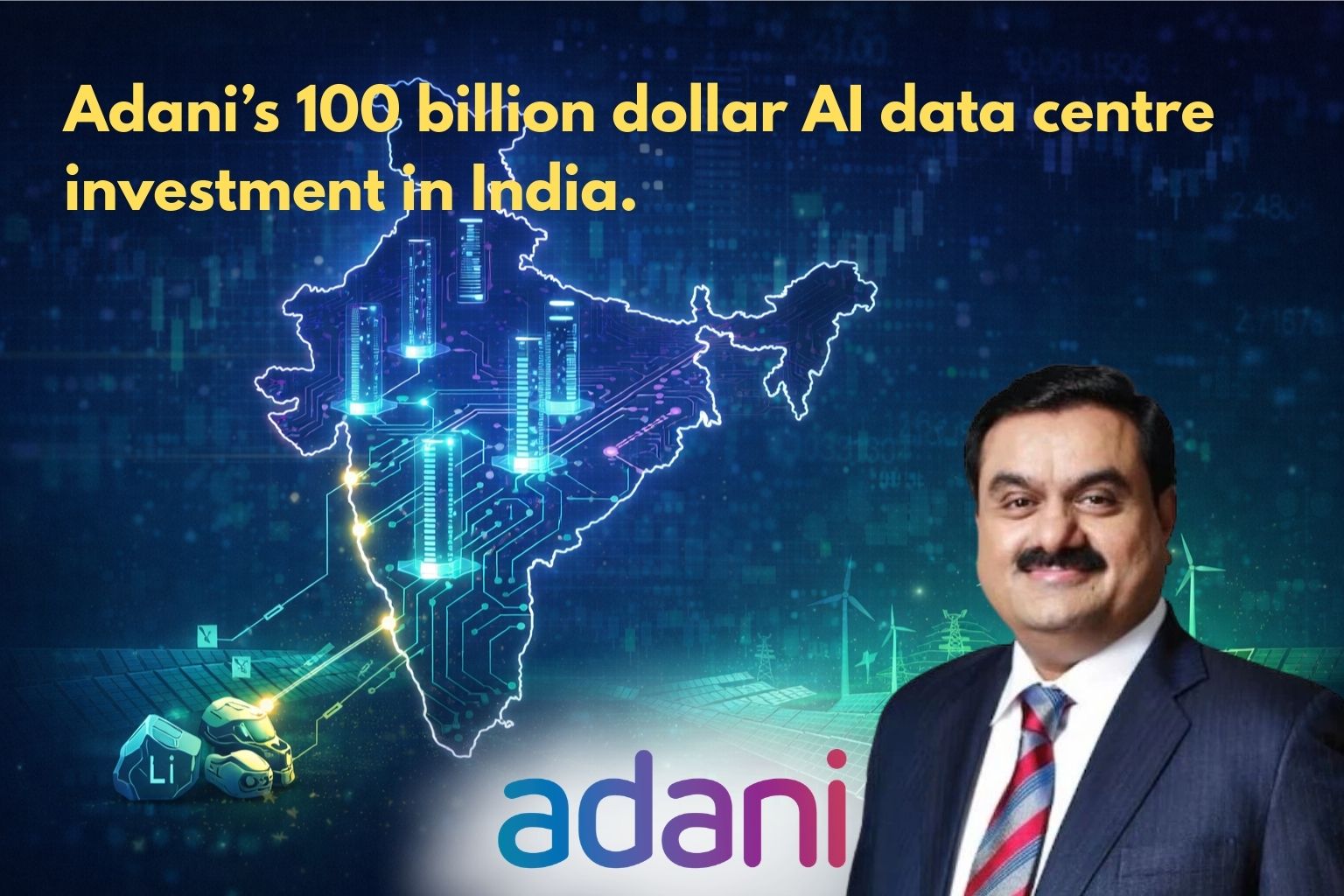
Adani Group plans to invest 100 billion dollars in renewable‑powered AI data centres across India by 2035, scaling capacity to about 5 GW and aiming to create the world’s largest integrated energy‑and‑compute platform. The initiative is expected to trigger another 150 billion dollars of investment in servers, electrical infrastructure and sovereign cloud platforms, forming a 250 billion dollar AI infrastructure ecosystem that could reshape India’s position as a global AI and data hub.
Table of Contents
- Chapter 1: The big picture: India’s data‑centre and AI runway
- Chapter 2: Strategic partnerships: proof of demand, not just supply
- Chapter 3: The structural theme: “Energy + Compute + Sovereign AI”
- Chapter 4: Capital flywheel: from 100B to 250B
- Chapter 5: Deep‑dive: stock‑style frameworks for this theme
- Trader‑oriented table: how different profiles might use this theme
These data centres are being designed as a unified “energy‑and‑compute” system—tightly integrating renewable generation, transmission, storage and high‑density AI compute—rather than as standalone server rooms scattered across cities. The aim is to make India’s AI workloads run on Indian soil, with Indian power, under Indian regulations—a direct play on sovereign AI.
The big picture: India’s data‑centre and AI runway
Before we zoom into stock‑style frameworks, it helps to understand the macro runway this adani ai data centre plan is trying to capture.
India’s data‑centre boom
Deloitte estimates that India may attract about 200 billion dollars of data‑centre investment by 2030, with capacity projected to rise from around 1.5 GW in 2025 to 8–10 GW by 2030. This would boost data‑centre power consumption from under 1% to roughly 3% of India’s total electricity demand by the end of the decade.
Colliers reports that India’s data‑centre sector has already attracted about 15 billion dollars since 2020 and is set to see another 20–25 billion dollars by 2030, with capacity across major cities expected to more than triple to over 4,500 MW. Another study suggests India’s colocation capacity alone could reach 8 GW by 2030 as data consumption, AI adoption and regulatory localisation accelerate.
Why this fits India’s policy direction
India’s digital‑economy push, data‑protection rules and broader “Atmanirbhar” (self‑reliance) agenda all favour local storage and processing of sensitive data. At the same time, global AI workloads are exploding, from consumer apps to enterprise tools and LLMs. Adani’s plan, explicitly described as “sovereign AI infrastructure”, aligns tightly with this policy and demand backdrop.
Strategic partnerships: proof of demand, not just supply
One of the biggest questions with any large infra build‑out is: who will actually use all this capacity?
Google, Microsoft and Flipkart as anchor partners
Adani is deepening its partnership with Google to build large‑scale AI data‑centre campuses in Visakhapatnam and Noida, part of a broader push to support Google’s cloud and AI services in India. At the same time, Adani is working with Microsoft on data‑centre sites in Hyderabad and Pune—two of India’s most important tech and SaaS hubs—integrated with the Azure cloud ecosystem.
On the commerce side, Adani is expanding its collaboration with Flipkart by developing a second AI‑focused data centre designed to handle advanced digital commerce, high‑performance computing and large‑scale AI workloads. These partnerships effectively underwrite utilisation and indicate that the adani ai data centre strategy is tied closely to real, large‑scale workloads, not just speculative capacity.
AdaniConnex: JV model to reduce execution risk
The platform driving this rollout is AdaniConnex, a 50:50 joint venture between Adani Group and US‑based EdgeConneX, a specialist in hyperscale and edge data centres. This structure brings international operating expertise and relationships with global hyperscalers, while keeping control and localisation with Adani in India. For investors, that can partly de‑risk technology and execution challenges.
The structural theme: “Energy + Compute + Sovereign AI”
Now let’s unpack the structural theme traders can use:
Core idea: India is trying to own both energy and compute so it can become a global AI and data hub on its own terms, and Adani is positioning itself as a key backbone provider for that shift.
1. Energy as the foundation
AI data centres are power‑hungry. Deloitte warns that India’s data‑centre power demand could rise by 40–45 TWh by 2030 and that adequate power supply and grid stability will be critical bottlenecks.
Adani Green Energy is already executing what it calls the world’s largest renewable project at Khavda in Gujarat, targeting 30 GW of capacity with more than 10 GW operational. The AI plan is explicitly built on top of this renewables base plus one of the world’s largest planned battery‑energy‑storage systems to stabilise supply.
Investor takeaway: The AI story is tied directly to the renewable story. If the AI infra scales, it creates a long‑term, high‑quality offtake engine for Adani’s renewable assets and potentially for other power and grid companies that plug into the ecosystem.
2. Compute and data‑centre capacity
The plan is to deploy up to 5 GW of AI‑grade data‑centre capacity, combining hyperscale campuses with advanced cooling and power architecture to support high‑density GPU clusters and next‑gen AI workloads. Facilities are being optimised for large language models, high‑performance computing and national‑scale data initiatives, with dedicated capacity for Indian LLMs and sovereign data projects.
In other words, Adani wants its AI data centres to be where India’s AI models are trained, fine‑tuned and deployed. That’s a different league of strategic importance compared with generic co‑location space.
3. Sovereign AI and localisation
Because India’s regulators are increasingly emphasising data protection and localisation, critical datasets in finance, healthcare, governance and citizen services will need compliant, local, high‑reliability infrastructure. Adani’s own communication repeatedly stresses “data sovereignty” and “sovereign AI infrastructure”, signalling a long‑term bet that this policy direction will strengthen, not weaken.
Structural theme in one line: India wants to store, process and monetise its own data using its own energy—Adani is building the rails for that.
Capital flywheel: from 100B to 250B
Here’s the investment flywheel the group itself is pointing to.
Table 1 – Adani AI data centre capital flywheel
| Layer | Amount (USD) | What it includes |
|---|---|---|
| Direct AI data centre investment | 100 billion | Renewable‑powered AI‑ready data centres up to 5 GW by 2035. |
| Induced investment in adjacencies | 150 billion | Servers, advanced electrical systems, sovereign cloud, manufacturing. |
| Total AI infrastructure ecosystem size | 250 billion | Combined impact expected over the decade in India. |
From a market perspective, the 100 billion is the direct Adani story; the remaining 150 billion is the broader India theme that spills over into many other listed and unlisted names.
Deep‑dive: stock‑style frameworks for this theme
Let’s translate the structural story into frameworks you can actually use while looking at charts, balance sheets and F&O screens. None of this is investment advice—it’s a way to organise your thinking.
Framework 1: Core, Adjacent and Peripheral plays
Think of three concentric circles around the adani ai data centre theme.
Core plays – directly tied to the project
These are names whose earnings, cash flows and valuations could be most directly influenced by the AI data‑centre rollout.
- Adani Enterprises – the flagship incubator hosting the AI infra platform and AdaniConnex stake, making it the purest listed play on this capex story.
- Adani Green Energy and other energy arms – providing renewable power and integrating storage and transmission with data‑centre demand.
Here, traders would track:
- Capex announcements and project milestones.
- Long‑term contracts with partners like Google, Microsoft and Flipkart.
- Funding mix (equity, debt, JV capital) and leverage metrics.
Adjacent plays – feed or benefit from the ecosystem
These may not be directly owned by Adani but are likely to benefit from the broader 250 billion dollar ecosystem.
- Power‑equipment and grid‑infra companies supplying transformers, switchgear, cables and high‑voltage infrastructure.
- Data‑centre REITs and real‑estate developers in hubs such as Mumbai, Hyderabad, Pune, Chennai, Noida and Vizag.
- Cloud, cybersecurity and networking firms that provide services on top of the AI data‑centre infrastructure.
These plays often benefit from rising order books, long‑term contracts and higher pricing power as demand tightens.
Peripheral plays – indirectly impacted
These gain from second‑order effects:
- Telecom and subsea‑cable companies connecting Indian data centres to global networks.
- AI‑driven SaaS, fintech and analytics firms that can scale faster once domestic compute becomes cheaper and more accessible.
Framework 2: Time‑horizon buckets
Different kinds of traders and investors can focus on different time frames.
Short term (0–12 months)
- Event trades around announcements: new campuses, regulatory approvals, major customer deals, policy support for AI infra, or big renewable project milestones.
- Sentiment swings around group leverage, rating reports, or macro headlines.
F&O traders may look at:
- Volatility spikes in Adani‑group stocks during news flow.
- Sectoral basket options (where available) in power/infra/IT around budget or policy events.
Medium term (1–3 years)
- Ramp‑up of initial campuses in Visakhapatnam, Noida, Hyderabad and Pune.
- Growth in India’s overall data‑centre capacity toward the 8–10 GW 2030 target and share captured by Adani.
- Cash‑flow visibility as long‑tenor contracts with hyperscalers and enterprises show up in reported numbers.
Here, investors might consider:
- Earnings revisions and valuation re‑rating potential for core and adjacent plays.
- Balance‑sheet strength and ability to sustain capex without unacceptable risk.
Long term (3–10 years)
- Structural shift in India’s position as an AI and data hub, supported by 250 billion dollars of cumulative AI infra investment.
- Deeper integration of renewable energy, grid storage and AI compute as a unique Indian advantage.
At this horizon, the question is less “What will next quarter’s EPS be?” and more “Which platforms will still dominate when India hits 8–10 GW of data‑centre capacity and beyond?”
Framework 3: Risk‑reward checklist
Before acting on any thematic story, it helps to run through a consistent checklist.
Key upside drivers
- Strong alignment with national policy on AI, data sovereignty and renewables.
- Anchor partners like Google, Microsoft and Flipkart validating demand.
- Vertical integration across power, transmission and compute, which can translate into cost advantages and operating control.
Key risks
- Funding and leverage: 100 billion dollars is large even when phased; markets will watch debt levels, refinancing and equity dilution closely.
- Execution: building and operating 5 GW of AI‑ready capacity with advanced cooling and grid integration is complex.
- Policy and geopolitics: shifts in data‑localisation rules, AI regulations, or export controls on GPUs and high‑end chips could affect timelines or costs.
Trader‑oriented table: how different profiles might use this theme
Below is a simple framework table for different market participants.
Table 2 – Structural theme playbook by trader profile
| Trader / investor type | Typical horizon | How they might use the theme (not advice) |
|---|---|---|
| Intraday / scalper | Intra‑day | Trade news spikes on Adani or sector stocks around major announcements. |
| Swing / positional | Days–months | Position around policy events, quarterly results, project milestones in core and adjacent stocks. |
| F&O / volatility trader | Days–weeks | Use options around big news flow for volatility strategies on Adani, power and infra indices. |
| Long‑term investor | 3–10 years | Build staggered exposure to structural winners across energy, infra and cloud as AI infra scales. |
FAQs
Adani Group plans to invest 100 billion dollars by 2035 to build renewable‑powered, AI‑ready data centres across India, expanding capacity to about 5 GW and creating what it calls the world’s largest integrated data‑centre platform.
The group expects its direct capex to catalyse about 150 billion dollars of additional investment in server manufacturing, advanced electrical systems, sovereign cloud platforms and other supporting industries, bringing the total AI infrastructure ecosystem impact to 250 billion dollars.
Data centres are energy‑intensive, and Deloitte estimates that India’s data‑centre power demand could rise to 40–45 TWh by 2030 as capacity climbs toward 8–10 GW. Adani is tying its AI strategy to large‑scale renewable projects like the 30‑GW Khavda park and significant battery‑storage investments to secure low‑cost, reliable power.
Adani is working with Google on major AI data‑centre campuses in Visakhapatnam and Noida, with Microsoft on projects in Hyderabad and Pune, and with Flipkart on a second AI‑focused data centre for digital commerce and large‑scale AI workloads.
Deloitte suggests India could attract around 200 billion dollars of data‑centre investment by 2030, with capacity rising from about 1.5 GW in 2025 to 8–10 GW by 2030. Colliers also notes that the sector has already drawn about 15 billion dollars since 2020 and may see 20–25 billion dollars more over the next six years.
Key risks include funding and leverage for such a large capex programme, execution challenges in building and operating 5 GW of AI‑grade capacity, grid and power‑supply constraints, and potential changes in data‑protection, AI or export‑control policies.