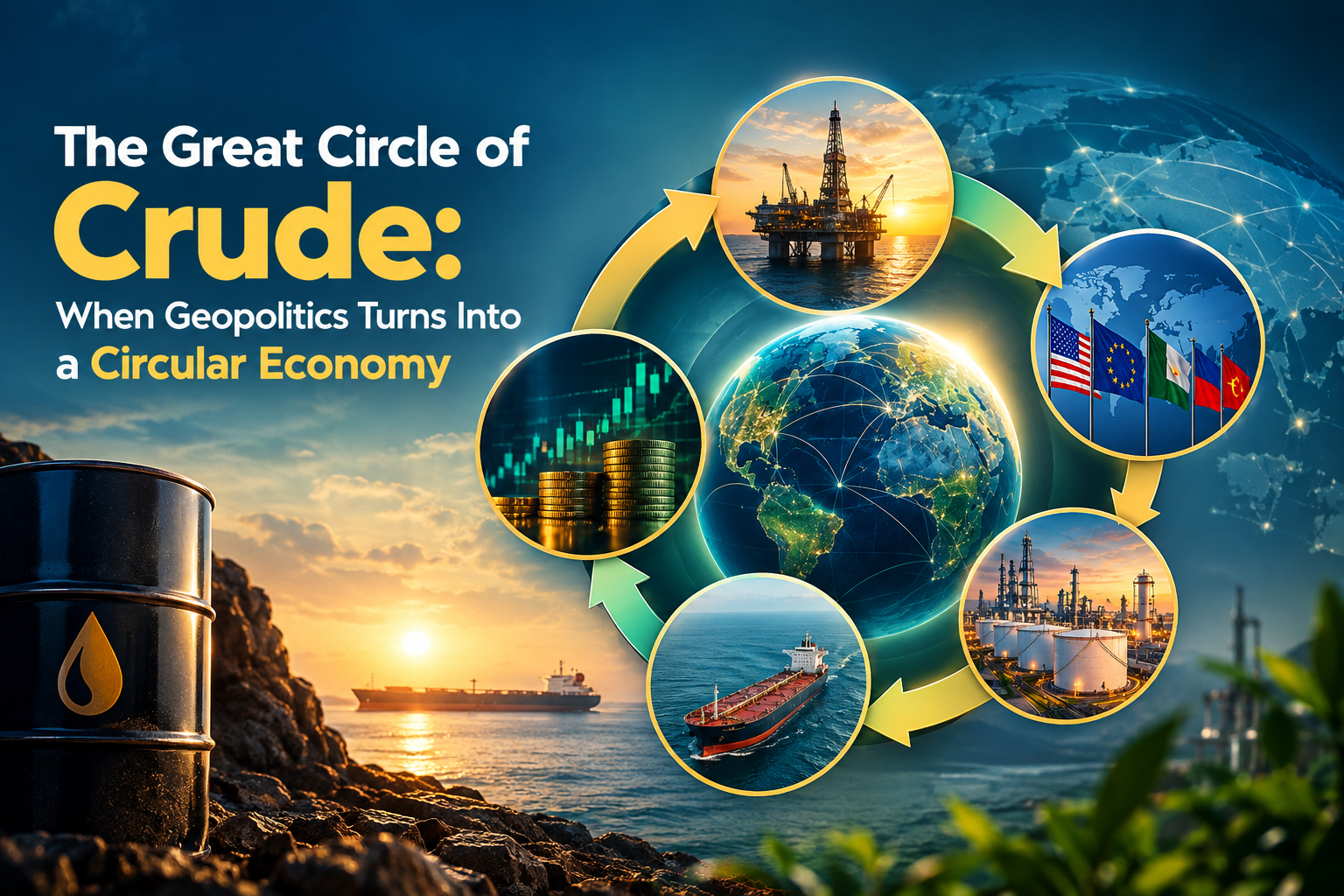
The Great Circle of Crude
Somewhere in the Urals, a barrel of Russian crude is loaded onto a tanker. It has no idea it is about to become the most morally flexible object on earth. The crude sails to Jamnagar, where India buys it at a “friendship discount.” India calls it strategic autonomy. The West calls it funding the war. The barrel calls it Tuesday.
Table of Contents
- Chapter 1: From Russian Crude to Indian Diesel
- Chapter 2: Europe Refuses Russian Oil — But Still Needs Diesel
- Chapter 3: America and the Selective Logic of Energy
- Chapter 4: Ukraine Enters the Circle
- Chapter 5: The Great Circle of Crude
- Chapter 6: The Final Ledger
- Chapter 7: The Barrel Has Its Own Journey
- Chapter 8: Everything Is Under Control
- Chapter 9: Conclusion
- Frequently Asked Questions
The Great Circle of Crude
Somewhere in the Urals, a barrel of Russian crude is loaded onto a tanker. It has no idea it is about to become the most morally flexible object on earth. The crude sails to Jamnagar, where India buys it at a “friendship discount.” India calls it strategic autonomy. The West calls it funding the war. The barrel calls it Tuesday. Then comes the miracle.
The crude enters an Indian refinery. It is heated, cracked and distilled. Russian molecules go in. Indian diesel comes out. Same molecules. New passport. It may be the only industrial process where sanctions become margins.
1. From Russian Crude to Indian Diesel
The journey begins with Russian crude being transported by tanker toward India. Once it reaches an Indian refinery, the crude goes through the refining process, where it is heated, cracked and distilled.
The result is a transformation from crude oil into refined fuel. In the context of this story, Russian molecules enter the refinery and Indian diesel comes out.
That creates the central irony behind the entire “Great Circle of Crude.” The original crude may have originated in Russia, but after being processed in India, the resulting fuel becomes part of a different stage of the global energy supply chain.
Russian molecules go in. Indian diesel comes out. Same molecules. New passport.
And that is where the commentary makes its sharpest observation: it may be the only industrial process where sanctions become margins.
2. Europe Refuses Russian Oil — But Still Needs Diesel
Europe then refuses Russian oil while continuing to require refined fuel. The contradiction becomes particularly striking when Indian diesel enters the picture.
The morning position is simple: “We stand firmly against Russian energy.”
Then comes lunch: “We need more diesel.”
The barrel, meanwhile, continues its journey through the global energy system.
The irony is captured in the line:
“Europe doesn’t buy Russian oil. It buys Russian oil that has been to finishing school.”
The crude has gone through an Indian refinery, and what emerges is refined fuel that can move through international markets. The route may have changed, but the underlying connection between crude, refining and fuel demand remains.
3. America and the Selective Logic of Energy
America gets angry at India for buying Russian crude and imposes tariffs to prove its principles. But the story then points to another contradiction: America continues importing Russian enriched uranium.
That creates the next layer of the geopolitical irony.
The commentary puts it bluntly:
“Because apparently principles, like fuel, need selective refining.”
The point of the comparison is the contrast between geopolitical positions and practical energy requirements. Countries may take strong positions on certain energy flows while continuing to participate in other parts of the same broader supply system.
4. Ukraine Enters the Circle
Then comes the ultimate plot twist.
Ukraine needs diesel. Europe provides the money. Ukraine buys Indian diesel. India buys Russian crude. Russia gets paid.
This creates the circular chain at the heart of the story:
Europe funds Ukraine → Ukraine buys Indian fuel → India buys Russian crude → Russia gets revenue → Russia keeps fighting → Ukraine needs more European money.
The supply chain and the financial flow therefore create a circular movement connecting countries that are otherwise positioned on opposite sides of the conflict.
The barrel continues moving through this system while the money keeps moving around it.
5. The Great Circle of Crude
This is where the story becomes a wonderfully circular economy.
Europe funds Ukraine. Ukraine buys Indian fuel. India buys Russian crude. Russia receives revenue. Russia keeps fighting. Ukraine needs more European money.
The cycle continues.
The barrel itself is simply part of a much larger system of global energy movement. It begins as Russian crude, travels to India, gets refined into diesel and then becomes part of the fuel supply reaching markets that still require energy.
The original commentary sums up the absurdity of this cycle with one line:
“The first war with a subscription model.”
6. The Final Ledger
The entire story can be viewed through a final geopolitical ledger.
- RU Russia: Monetising the war.
- UA Ukraine: Fighting Russia with fuel ultimately sourced from Russia.
- EU Europe: Morally clean. Operationally Indian-fuelled.
- US America: Outraged… selectively.
- IN India: Refining everyone’s geopolitical contradictions into a margin.
Each participant occupies a different position in the geopolitical story, but the energy and financial flows continue to connect them.
That is what makes the Great Circle of Crude such an unusual story. The same global system that separates countries politically can still connect them economically through energy.
7. The Barrel Has Its Own Journey
And then there is the barrel.
It has travelled farther than most diplomats and accomplished more.
From the Urals to a tanker, from the tanker to Jamnagar, from crude to refined diesel and from there into a much larger international fuel network, its journey crosses multiple geopolitical boundaries.
The barrel does not care about the political arguments surrounding it.
It simply moves through the supply chain.
And in doing so, it becomes a symbol of the contradictions created when global energy demand meets geopolitics.
8. Everything Is Under Control
The money keeps circling the globe like a vessel on Dynamic Positioning—burning enormous amounts of energy, going nowhere, while everyone on the bridge insists:
“Everything is under control.”
That final comparison captures the central irony of the entire story.
The route may appear complicated. The geopolitical positions may appear contradictory. The money and energy may move through multiple countries and markets.
Yet the system continues moving.
The barrel keeps travelling.
The money keeps circling.
And everyone remains on the bridge insisting that everything is under control.
9. Conclusion
The Great Circle of Crude is ultimately a story about the strange contradictions that can emerge when crude oil, refining, sanctions, geopolitical interests and fuel demand intersect.
Russian crude moves to India. India refines it into diesel. Europe continues to need fuel. Ukraine needs diesel. Europe provides money. India buys Russian crude. Russia receives revenue.
The circle continues.
And the barrel?
It has travelled farther than most diplomats and accomplished more.
The money keeps circling the globe like a vessel on Dynamic Positioning—burning enormous amounts of energy, going nowhere, while everyone on the bridge insists:
“Everything is under control.” 🚢😂
Frequently Asked Questions
The Great Circle of Crude describes the circular flow presented in the article, where Russian crude moves to India, is refined into fuel, and Indian diesel then becomes part of the fuel supply reaching European and Ukrainian markets.
According to the provided content, the crude enters an Indian refinery where it is heated, cracked and distilled. Russian crude goes in, while Indian diesel comes out.
The phrase humorously refers to Russian crude being processed in an Indian refinery and emerging as refined fuel. The original commentary uses this line to highlight the geopolitical irony of the refining process.
In the supplied content, India views the purchase of Russian crude through the lens of strategic autonomy, while the West views it as contributing to funding the war.
The article describes Europe as refusing Russian oil while continuing to need diesel. The supplied commentary highlights the irony of Europe receiving Indian refined fuel even though the crude used in the process originated in Russia.
According to the supplied content, Ukraine needs diesel, Europe provides the money, Ukraine buys Indian diesel, India buys Russian crude and Russia receives revenue. This creates the circular flow described in the article.
The article presents the flow as:
Europe funds Ukraine → Ukraine buys Indian fuel → India buys Russian crude → Russia gets revenue → Russia keeps fighting → Ukraine needs more European money.
It is a satirical description of the recurring financial and energy cycle presented in the article, where European support, Ukrainian fuel requirements, Indian refining and Russian crude revenue continue to feed into the same broader cycle.
The supplied commentary presents the ledger as follows: Russia is monetising the war; Ukraine is fighting Russia with fuel ultimately sourced from Russia; Europe is described as morally clean but operationally Indian-fuelled; America is described as selectively outraged; and India is refining geopolitical contradictions into a margin.
The article compares the circulating money and energy flows to a vessel on Dynamic Positioning, burning enormous amounts of energy while going nowhere, while everyone on the bridge insists that “Everything is under control.” This is the final satirical comparison used to describe the circular nature of the situation.