Why did the NIFTY Midcap 100 recover sharply after the July 8 panic fall?
The sharp recovery after the July 8 intraday fall highlights how markets often move from panic to recovery. When fear forces weaker participants to exit, institutional investors and stronger market participants may step in, leading to renewed buying interest and potential new highs.
Table of Contents
- Chapter 1: A Panic That Shook the Midcap Market
- Chapter 2: The July 8 Panic: When Fear Took Over
- Chapter 3: What Happened Just Two Days Later?
- Chapter 4: Understanding Market Psychology
- Chapter 5: Why the Market Stalled After Making a New High
- Chapter 6: Why the Current Correction Matters
- Chapter 7: The Biggest Lesson for Investors
- Chapter 8: How Q7 Trading Solutions Approaches Market Volatility
- Chapter 9: Conclusion
- Chapter 10: Frequently Asked Questions
A Panic That Shook the Midcap Market
Stock market corrections often create panic among retail investors. Sharp declines trigger fear, uncertainty, and emotional decision-making, causing many participants to exit their positions at the worst possible time.
A recent move in the NIFTY Midcap 100 Index provides an interesting example of how market psychology can influence price action.
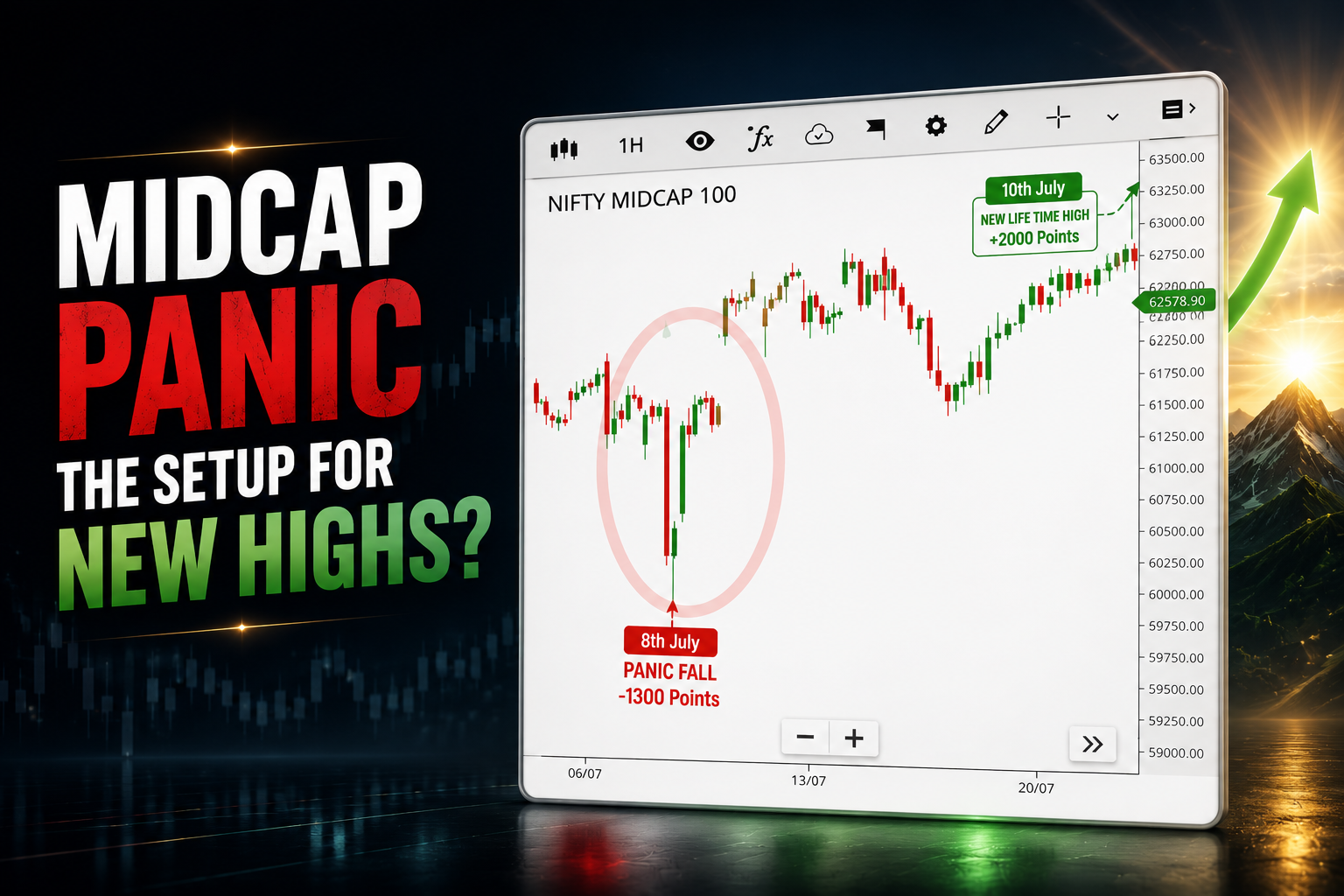
On 8th July, the Midcap Index witnessed an intraday decline of nearly 1,300 points, creating widespread panic across the market. Many investors interpreted the fall as the beginning of a larger correction.
However, the market had a different plan.
Within just two trading sessions, by 10th July, the index recovered more than 2,000 points, crossed the historic 63,000 mark, and registered a new lifetime high.
This sharp reversal offers valuable lessons about market behaviour, investor psychology, and the importance of disciplined investing.
The July 8 Panic: When Fear Took Over
The sudden decline on 8th July created significant anxiety among market participants.
Large red candles on the chart often encourage emotional reactions. Investors begin questioning whether they should exit immediately to avoid larger losses.
During such periods, selling pressure generally increases because many retail traders focus more on protecting short-term capital than understanding the broader market structure.
This emotional response is common in every market cycle.
What Happened Just Two Days Later?
Instead of continuing lower, the market staged a remarkable recovery. By 10th July, the NIFTY Midcap 100 had recovered more than 2,000 points and created a fresh all-time high above 63,000. The same investors who sold during panic suddenly found themselves watching the market move higher without them. This rapid turnaround highlights how quickly market sentiment can change.
Understanding Market Psychology
Markets are driven not only by economic data and corporate earnings but also by investor behaviour.
During corrections:
- Fear encourages selling.
- Confidence disappears.
- Many participants exit simply because others are selling.
When selling pressure exhausts itself, stronger participants often begin accumulating quality stocks at attractive prices.
As buying gradually increases, prices recover, confidence returns, and new participants enter after the rally has already begun.
This cycle repeats across different market phases.
Why the Market Stalled After Making a New High
Following the strong recovery, the Midcap Index remained largely range-bound for nearly two weeks. One possible explanation is that after the sharp rally, many retail investors entered the market near higher levels, expecting the momentum to continue immediately. When buying enthusiasm becomes concentrated near market highs, price movements often slow as markets consolidate before deciding their next direction. Consolidation is a normal part of healthy market trends.
Why the Current Correction Matters
The latest decline has once again increased uncertainty among investors.
• Market corrections frequently test conviction before establishing the next directional move.
Some market participants believe that when weaker hands exit during periods of volatility, stronger institutional participation may gradually support the next phase of the rally.
• Every correction has the potential to reset market sentiment.
• Every recovery begins only after fear starts to fade.
While no outcome is guaranteed, many analysts continue to monitor whether the NIFTY Midcap 100 can eventually move towards the 65,000 level if broader market conditions remain supportive.
• Market projections are possibilities—not certainties.
Investors should remember that every market forecast involves uncertainty and should always be viewed alongside proper risk management and individual investment objectives.
The Biggest Lesson for Investors
One of the most important lessons from recent market action is that emotions often become an investor’s biggest obstacle.
Selling during panic and buying after excitement has historically led many investors to underperform.
Successful investing generally requires:
- Patience during corrections.
- Discipline during rallies.
- A long-term perspective.
- Risk management.
- A systematic investment process.
Markets will always experience periods of volatility, but disciplined decision-making often proves more valuable than emotional reactions.
How Q7 Trading Solutions Approaches Market Volatility
At Q7 Trading Solutions, we believe consistency comes from following predefined strategies rather than emotional decisions.
Our algorithmic trading approach is designed to execute systematic strategies based on data-driven rules while adapting to changing market conditions.
Instead of reacting emotionally to every market swing, systematic execution aims to maintain discipline throughout different phases of the market cycle.
I am text block. Click edit button to change this text. Lorem ipsum dolor sit amet, consectetur adipiscing elit. Ut elit tellus, luctus nec ullamcorper mattis, pulvinar dapibus leo.
Conclusion
The July 8 correction and the sharp recovery that followed demonstrate just how quickly market sentiment can change.
While short-term volatility often creates fear, it can also create opportunities for disciplined investors who remain focused on process rather than emotion.
• Markets are driven by both fundamentals and investor psychology.
• Volatility is temporary, but discipline is timeless.
Whether the NIFTY Midcap 100 eventually reaches new milestones will depend on market conditions, corporate earnings, liquidity, and broader economic factors.
• No market move is guaranteed, but a disciplined approach helps investors navigate uncertainty with greater confidence.
At Q7 Trading Solutions, we continue to monitor evolving market trends and use systematic, algorithm-driven strategies to help traders navigate changing market conditions with consistency and discipline.
📩 Telegram Support: @q7sales_support
Frequently Asked Questions
The index experienced a sharp intraday correction of around 1,300 points, triggering widespread panic among market participants.
The Midcap index recovered more than 2,000 points within two trading sessions and reached a new lifetime high above 63,000 on July 10.
Panic selling can create opportunities for stronger market participants to accumulate positions, which may support a recovery when buying interest returns.
Corrections often help remove excess speculation from the market and can create conditions for a healthier trend if buying momentum returns.
Q7 Trading Solutions uses a disciplined algorithmic trading approach designed to reduce emotional decision-making and execute predefined trading strategies.