Does holding stocks for the long term always create wealth?
No. Long-term investing does not automatically create wealth. Investment success depends on owning fundamentally strong stocks with sustained growth potential. Holding underperforming stocks for years can lead to limited returns, making periodic portfolio review and disciplined investing essential.
Introduction
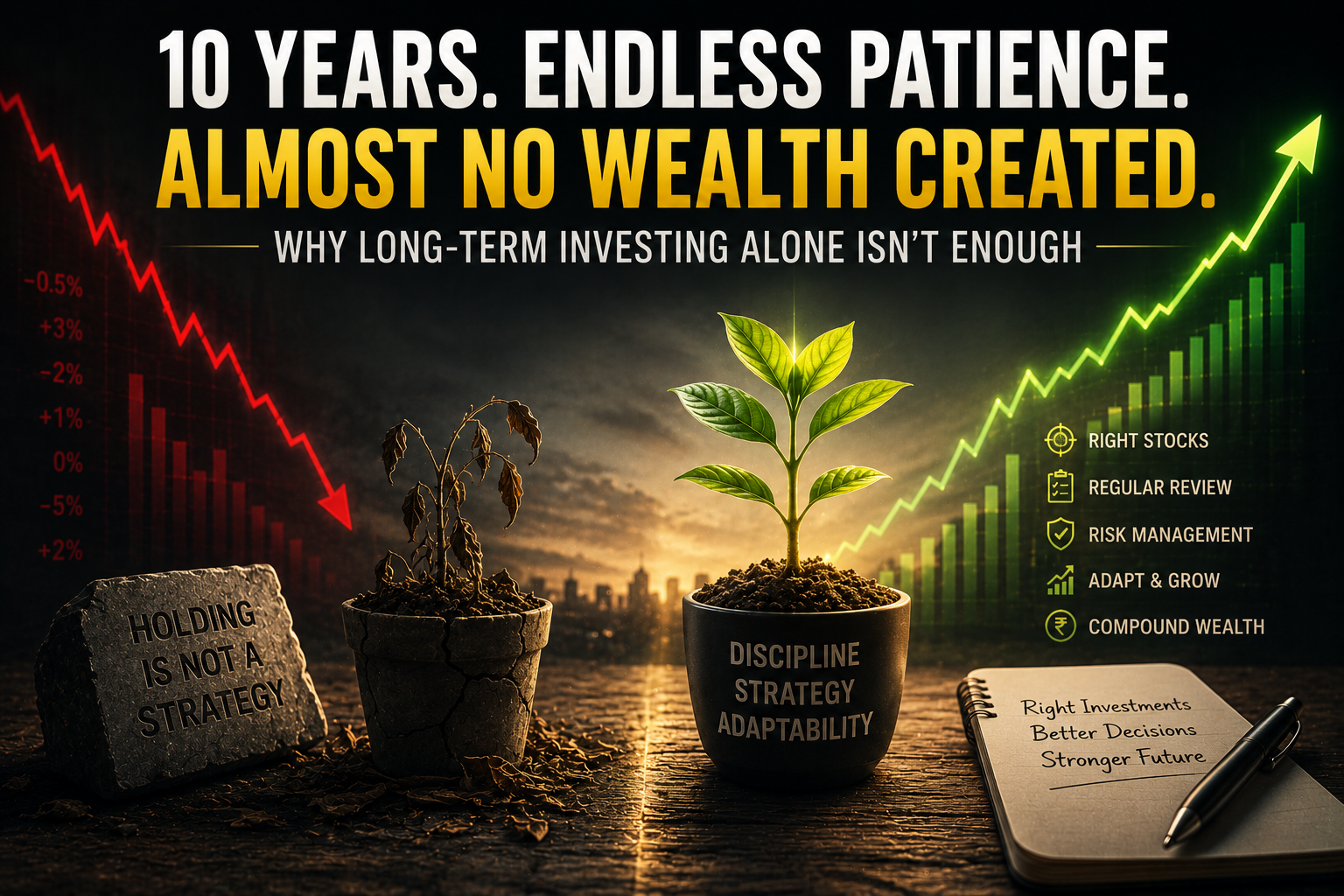
One of the most common pieces of investment advice is, “Invest for the long term.” While patience is undoubtedly one of the greatest qualities an investor can have, time alone does not guarantee wealth creation. The real question is not how long you stay invested, but what you stay invested in. Over the past decade, several well-known companies have delivered little to no meaningful returns despite investors holding them patiently for years. This highlights an important reality: long-term investing works only when the underlying business continues to create value.
Time Alone Doesn’t Build Wealth
Many investors believe that once they buy shares of established companies, all they need to do is hold them indefinitely. However, market history tells a different story. Even strong brands can go through prolonged periods of stagnant performance, changing industry dynamics, or slower business growth. As a result, investors who simply “buy and forget” may find that years of patience generate very little wealth.
Some of the companies that have shown limited returns over the last decade include:
- PVR INOX – -0.5%
- Hero MotoCorp – +4%
- ACC – -2%
- Just Dial – +3%
- Symphony – -5%
- Indus Towers – +1%
- Blue Dart – -2%
- ITC – +2%
- Dabur – +3%
- PNB – -2%
- Emami – -5%
- Bata India – +2%
- SPARC – -5%
- Whirlpool – 0%
- Network18 – -3%
- Castrol India – -1%
- Nilkamal – +1.5%
- Huhtamaki India – -2%
- LIC Housing Finance – +1%
- VST Industries – +2%
- Kiri Industries – +1.5%
- IDBI Bank – +2%
- Amara Raja Energy & Mobility – 0%
- Jyothy Labs – +3%
- Shoppers Stop – +1%
- JK Lakshmi Cement – +3%
These are not obscure businesses. They are established companies that many investors considered long-term holdings. Yet, while investors waited patiently, several other sectors and companies generated significantly stronger returns.
The Biggest Investing Lesson
The biggest takeaway is that successful investing is not about buying a stock and forgetting about it forever. Markets evolve, industries change, and businesses go through different growth cycles. Investors who regularly review their portfolios are often better positioned to identify opportunities and respond to changing market conditions.
A disciplined investment process generally focuses on:
- Selecting fundamentally strong businesses.
- Reviewing investments periodically.
- Exiting positions when trends weaken.
- Reallocating capital into stronger opportunities.
- Making decisions based on predefined rules instead of emotions.
Patience remains important, but patience without evaluation can become costly.
Why Systematic Investing Matters
One of the biggest reasons investors underperform is emotional attachment. Many continue holding underperforming stocks simply because they have owned them for years or hope prices will eventually recover. Others hesitate to shift capital into better opportunities because they fear making the wrong decision.
A systematic investment approach reduces this emotional bias by relying on predefined rules rather than hope or fear. Instead of reacting emotionally, it evaluates market conditions objectively and makes decisions based on data and strategy.
Markets reward adaptability as much as patience, and disciplined investors understand that protecting capital is just as important as growing it.
How Algorithmic Investing Can Help
At Q7 Trading Solutions, we believe consistency is one of the most valuable characteristics of successful investing. Our algorithmic investing approach is designed to follow predefined strategies that help identify opportunities, manage risk, and adapt to changing market conditions without emotional interference.
Rather than becoming attached to individual stocks, a systematic approach continuously evaluates whether an investment still meets its predefined criteria. When market conditions change, the strategy changes with them. This allows investors to focus on disciplined execution instead of emotional decision-making.
Long-term investing remains one of the most effective ways to build wealth, but only when combined with intelligent stock selection and regular portfolio evaluation. Holding every stock forever is not a strategy—it is an assumption that every business will continue creating value indefinitely.
Successful investing is built on patience, discipline, and the ability to adapt as markets evolve. At Q7 Trading Solutions, we combine data-driven analysis with algorithmic execution to help investors navigate changing market conditions through a systematic and disciplined approach.
Frequently Asked Questions
No. Long-term investing alone does not guarantee wealth creation. Investment success depends on selecting fundamentally strong companies, monitoring their performance, and adapting your portfolio as market conditions evolve.
Even established companies can experience slowing growth, increased competition, changing consumer preferences, or industry disruptions. These factors can limit returns despite long holding periods.
Yes. Periodic portfolio reviews help investors assess whether companies continue to meet their investment objectives, allowing them to rebalance or reallocate capital when necessary.
Systematic investing follows predefined rules and data-driven strategies instead of emotional decisions. It helps investors maintain discipline by focusing on objective investment criteria.
Algorithmic investing uses predefined trading and investment rules to identify opportunities, manage risk, and execute decisions consistently. It removes emotional biases like fear, greed, and hesitation from the investment process.
Q7 Trading Solutions believes disciplined execution leads to better consistency. Its algorithmic strategies continuously evaluate market conditions, helping investors follow systematic, data-driven investment decisions rather than emotional reactions.